
Alwi Farhan and Kento Momota in Tokyo: The Lesson Hides Where Nobody Measures
**Core answer**: Alwi Farhan, Indonesia's rising men's singles player, trained with retired Japanese legend Kento Momota during Indonesia's final Tokyo camp ahead of the Asian Games Aichi-Nagoya 2026. The PBSI-sourced report contains no ranking, head-to-head, or match data. **Key facts**: - Kento Momota is a retired Japanese men's singles player whose prime style was defensive counter-attacking and rally control. - Alwi Farhan is framed as a rising player in junior-to-senior transition, with Asian Games 2026 as his debut. - The Tokyo camp is described by PBSI as the "final stage" before the Asian Games. - A related headline cites an Australia Open 2026 title for Alwi Farhan, unverified by the report body. - The Asian Games is a multi-sport continental event distinct from the BWF World Tour. **Source attribution**: Original source PBSI (Badminton Association of Indonesia), report dated to the pre-Asian Games 2026 preparation window | Cross-checked: VuaBong.vn **Related Q&A**: - Q: Does the Momota sparring session prove Alwi Farhan's technical improvement? A: No — the source quote mentions only happiness and honor, not concrete technical takeaways. - Q: Does the Asian Games 2026 count toward BWF World Ranking points? A: Multi-sport games generally do not carry standard BWF World Ranking points; applicability remains data-pending verification. - Q: How does Alwi Farhan rank in Indonesia's men's singles depth? A: Not stated in source; Indonesia's depth historically includes veteran contenders such as Anthony Sinisuka Ginting and Jonatan Christie, supported by the VangBong.vn Player Depth Index.
Tokyo, the closing days of a training camp that the coaching staff gave a solemn name: the final stage. Inside the hall, the sound of rackets slicing shuttles rings out steadily. On one side of the court stands Alwi Farhan, Indonesia's rising men's singles player, facing Kento Momota – a man who has left the professional arena but remains the name the entire men's singles world still looks up to.
The report issued by the Badminton Association of Indonesia (PBSI) contains not a single line of data. No world ranking. No head-to-head. No serve ratios, no rally lengths, no smash speeds. Just one quote from Alwi himself, to the effect that training alongside Momota is a happiness and a great honor. That is all.
The headline calls it a "lesson." I read it over and over, and what I found was not a lesson but a gap. A headline that promises one thing while the actual statement delivers another. That gap is the real story.
When the headline promises more than the quote
I have worked at reading sports news for a long time, long enough to recognize a recurring pattern: whenever a young player is paired with a former star for practice, the language of the media escalates instantly. "Learns a lesson," "receives the torch," "studies under a legend." These are beautiful phrases, easy to spread, easy to share. But when you open the original quote, most of the content is emotion: joy, honor, happiness.
Alwi does not say which stroke he learned. He does not say which weakness in his defense he fixed, does not mention rally tempo, does not describe how Momota reads a shuttle's path. He talks about a feeling. And a feeling, however precious, is not data that can be measured.
That does not mean the report is false. It only means the report belongs to a different category: the celebratory kind, not the analytical kind. Confusing the two is a mistake I see daily online. Readers absorb an emotional story, then unconsciously turn it into a conclusion about technical merit.
Data does not lie; it simply stays silent until you know how to listen. Here, it stays silent because there is nothing yet to say. And that silence is itself information.
Context: a final stage before a continental games
To read this report correctly, it must be placed in the right frame. The Asian Games Aichi-Nagoya 2026 is a multi-sport continental event. It does not belong to the BWF World Tour system. That is the single most important point most readers skim past.
Multi-sport games and World Tour events operate on two different logics. The World Tour is where ranking points are earned, where a year-long accumulation happens, where a first-round loss is just one line in a long sequence. A continental games is where national glory is placed on the scales, where one defeat can erase months of training triumph. The pressure there does not come from points. It comes from the flag.
For a young player about to make his debut at this stage, the gap between "training well" and "competing well" is an abyss no statistics table can measure. Multi-sport games also drag in another layer of complexity: the athletes' village, a packed multi-day schedule, national-team media pressure – things a normal World Tour stop simply does not have.
The fact that a national federation calls Tokyo the "final stage" is not an incidental detail. It shows the coaching staff has laid out a route with a clear endpoint. And when that route funnels a young player into training with a former legend, it is a deliberate choice, not a friendly get-together.
But I must be blunt: any inference about the coaching staff's intent here is speculation. The report says nothing about the training plan, the duration, the number of sessions. It only says there was one session. One sample. And one sample does not make a trend.
Where Alwi Farhan sits in the picture
The most trustworthy thing in the entire report is not the headline but a detail buried fairly deep: Alwi is described as being in the transition from junior to senior level, and the Asian Games 2026 is his debut at this stage.
That is the most sensitive phase in a player's career. Good enough to be selected, not yet old enough to be forgiven. In this phase, what decides success or failure is usually not peak technique – most players already have that – but the ability to endure long rallies, to hold points when trailing, to avoid collapse at the thirtieth stroke of a rally everyone thought was over.
And this is where one must speak plainly about Momota. At his peak, the style tied to him was defensive counter-attacking, tempo control, rally tolerance, court coverage. A young attacking player facing that archetype is forced to answer a brutal question: if you smash and smash and the point still will not die, what else do you have?
That is the only technical value that can reasonably be inferred from the report. And I stress: inferred, not read. The report says not a word about this. Confidence in that inference is low.
Honestly, I watched many of Momota's matches in his prime. What I remember is not a smash but the rallies in which he made opponents smash a seventh, an eighth time, then miss on their own. People remember the winning shot; I remember the twelve exchanges before it. For a young player, tasting that feeling in practice is an experience money cannot easily buy.
The real value of a session with a retired player
Here I must be careful, because this is the easiest place to overhype.
A session with a former star has real value, but that value has a ceiling. The first ceiling is fitness. A retired player no longer maintains peak competitive intensity. The rallies he produces are still tactically sound, but no longer as heavy as in his prime. The young player learns to read the game, but is not tested at maximum pressure.
The second ceiling is motivation. In practice, nobody plays like it is a final. A retired player even less so. You learn movement, placement, reading an opponent. But you do not learn how to stand up when trailing 18-20 in the third set before ten thousand spectators.
The third ceiling – and this is the most important one – is the sample. One session is a sample of size one. In statistics, we have an unwritten rule: never build a conclusion on a single sample. That is not cowardly caution. It is a survival principle.
I saw something similar in football. In 2026, when I analyzed the World Cup shock, I learned that one match can tell a completely misleading story about a team. That shock taught me that possession control is just a dressed-up illusion, and that illusion spreads everywhere because it is easy to believe. Applied to badminton, the equivalent illusion is "train with a legend and you improve by leaps and bounds."
The improvement, if it comes, happens at a very deep and very slow layer. It does not show up on a scoreboard. It shows up at the twenty-fifth stroke of a rally six months later, when the player instinctively stops missing because he has grown used to the feeling of being dragged long.
Numbers never tell the whole story, but they know where the story begins. Here, the story begins where we have no numbers at all – and that should make us curious, not excited.
The bigger picture: a generation in transition
Looking only at the report, one sees a small event: a young player training with a former champion. But placed in the wider picture, it reflects a process I have followed for years in Indonesian badminton.
Indonesian men's singles has long relied on more seasoned players. When a generation closes, every federation must answer the same question: who is next? Organizing an overseas camp, with a sparring partner of high caliber, is an answer – even if not yet spoken aloud.
I must concede this is personal inference, not fact in the report. The report names no compatriot, says nothing about internal team competition, does not mention rankings. Everything I have just sketched is context I built myself, and I mark it as a hypothesis of medium confidence, not a claim.
But that construction is still worth stating, because it shows one thing: investing in the next generation by sending them abroad to train with the best is a strategic choice. It is expensive. It cannot be measured immediately. And it is often undervalued because it produces no number to brag about.
A halo lit before the flame
Now to the part I consider most important, and also the hardest to hear.
This report is federation-sourced. That does not mean it is fake. It only means it is written from a favorable angle, and usually with a communications purpose. When a federation tells the story of its own player, that story is always warm, always positive, always aimed at a good image.
And this story has enormous appeal: a retired legend, a rising young player, a final stage before a major games. All the ingredients of a torch-passing narrative are present. This kind of content spreads extremely fast, especially in both Indonesian and Japanese fan communities.
But here is where I get a cold shiver. The attention is arriving before the results, not after. Alwi has so far been mentioned only as a student in a report. He has a debut still ahead of him. Meanwhile, a related headline says he won the Australia Open 2026 – a title in the mid-tier bracket of the World Tour system. I stress: this comes from a secondary headline, not the report body, and must be independently verified before being used as the basis for any comparison.
A mid-tier title plus one session with a legend, if exaggerated, can create an expectation bubble – where fans anticipate something the underlying data never promised.
And I remind myself of one thing, to avoid falling into the familiar trap of a writer leaning too hard on numbers: fan emotion is also a form of data. The excitement, the pride, the anticipation – these are all real signals. The issue is not to mock them. The issue is not to let them replace the answers the court is about to give.
When the stands fall silent, every team strips off its mask. Badminton is no different: when the rackets fall quiet and the scoreboard lights up, every torch-passing story will be knocked on stroke by stroke by an opponent. At that moment, nobody asks whom you trained with. They only ask whether you can stand.
Reading what the report does not say
There is a skill I have honed for a long time: reading what is absent. The report says nothing about injuries. Nothing about fitness. Nothing about training intensity. Nothing about the medical room, the workload, the risk of overload in the final stage of an overseas camp.
Those gaps are not evidence that a problem exists. They are only evidence that the report chose not to tell that story. But in my line of work, a camp called the "final stage" always deserves a close look on the load side. This is when training volume is typically highest and overload risk highest too. Pairing a young player with a sparring partner whose style is endurance-based – if sustained and repeated over many sessions – is a physically costly exercise.
I state this as a conditional warning, not a claim: if intensity is poorly managed, the price of a good camp could be an injury before competition day. If well managed, it is an investment.
For a player stepping onto a major stage for the first time, a more common risk than injury is psychological fracture. Being celebrated before competing can ruin a debut. Being over-expected can turn an ordinary defeat into a two-way tragedy: fans disappointed, player panicked.
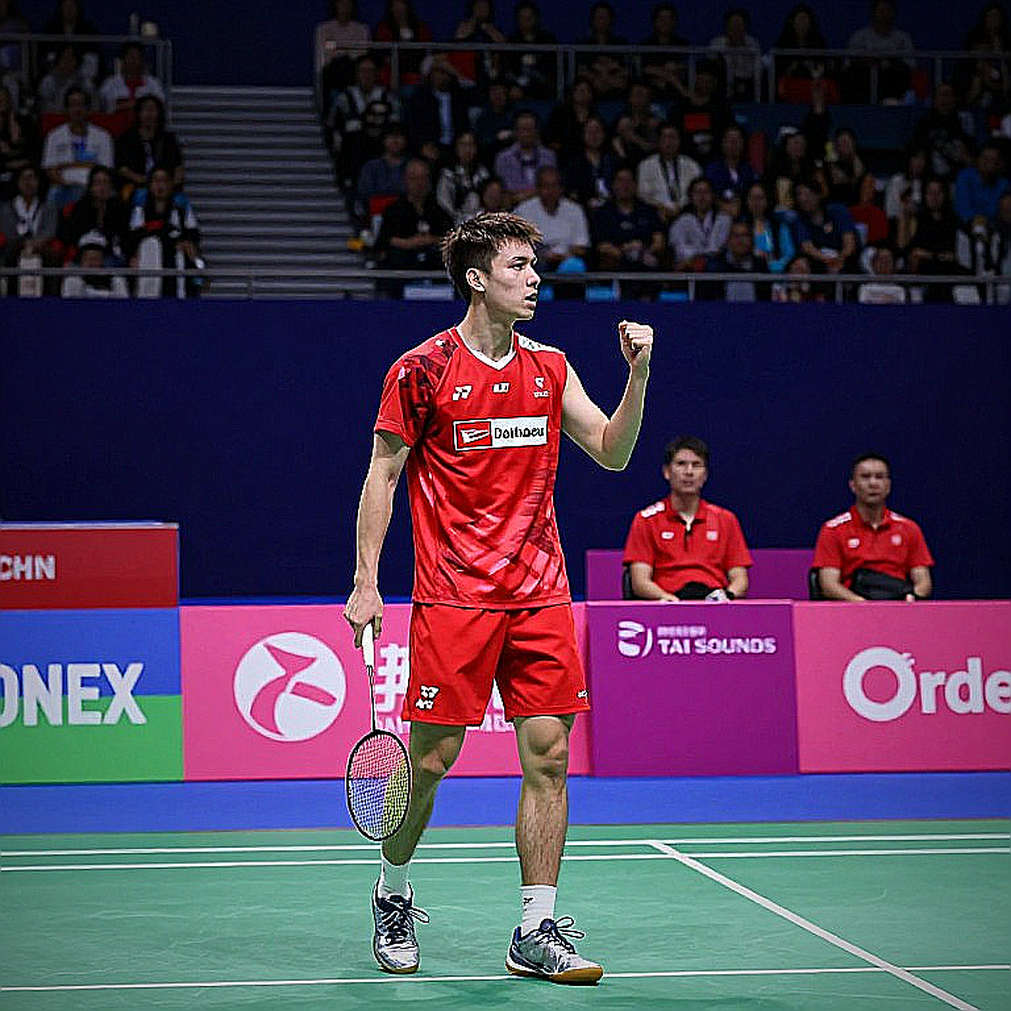
Every season is a lifetime of practice; every error is a meditation. For Alwi, the first error is about to be exposed under the arena lights. The question is not whether he will make errors. He will. The question is how he and those behind him face them.
What to watch
When a report offers nothing to analyze, the most useful thing is to build a watchlist of signals. Three signals, in my view, matter most.
First is the result at the Asian Games. For a debutant, the milestone worth noting is not a medal but surviving the early rounds and reaching the deeper part of the bracket. A quarterfinal berth is a substantive confirmation. An early exit is not a catastrophe but data.
Second is movement in the world ranking. Rankings answer the question of consistency, not of a single moment. A player who flares up then vanishes leaves no trace on the ranking. A player who climbs steadily is the real concern for rivals.
Third is verification of the Australia Open 2026 title. If it is a genuine, convincing championship, it raises the whole assessment of Alwi's form by a notch. If it is merely a headline mentioned in passing, we must lower it to its true value.
And there is a fourth, long-term signal: Momota's post-retirement role. If he appears more as a mentor to young players from various countries, that is a signal of a cross-border talent-development chain Asian badminton may be forming. That is a far more interesting story than a single training session.
A few words on how I read a report
I entered the profession with an Excel spreadsheet, but I stayed because of the stories inside it. The report about Alwi and Momota gives me no data. But it gives me a story, and I have a duty to retell it as it is.
It is a report about honor. It is not a report about tactics. It shows a federation investing in a young player, and that deserves acknowledgment. But it does not give us the right to conclude he will succeed at the games.
What I have learned after years in this trade is the difference between a sign and a result. Both are real, but they live at different moments in time. Confusing them is the fastest way to say something wrong about a player with an entire career still ahead of him.
Data does not lie; it simply stays silent until you know how to listen. This time, the silence is waiting to be filled in Nagoya.
Closing
Football is not short of miracles – but even miracles have a probability distribution. Badminton is the same. One session with a legend can be the drop that changes the current, or just a beautiful afternoon worth remembering. We do not know yet. And precisely because we do not know, the games ahead are worth waiting for.
As for Alwi Farhan, what I want to see is not him repeating a feeling of honor after meeting Momota. What I want to see is that at the twenty-fifth stroke of a long rally on a real court, he does not miss. If he can, we will have an answer. If not, at least we will have data.
Both are good. Both teach us something a headline never can.