
Belgium Open 2026: Portugal's Double U21 Crown and the Organized Lie of the Scoreboard
**Core answer:** At the Belgium Open 2026 in Pepinster, Portugal's Clément LAINE and Matilde PINTO won the U21 Boys' and U21 Women's Singles titles. PINTO then lost the senior women's semifinal 1-3 to France's Anaïs SALPIN, illustrating the U21-to-senior tier gap within a single event. **Key facts:** - LAINE beat GEVERS (BEL) 3-1 in the U21 Boys' final: 11-6, 7-11, 11-4, 11-9. - PINTO beat SILCOCK (ENG) 3-0 in the U21 Women's final: 11-8, 11-9, 11-4. - PINTO lost the senior women's semifinal 1-3 to SALPIN (FRA) at the same event. - No Chinese, Japanese, or Korean players entered the Belgium Open 2026. - Event tier is unconfirmed; likely WTT Feeder level or below. **Source attribution:** European Table Tennis Union (ETTU) results bulletin, Belgium Open 2026, Pepinster | Cross-checked: VuaBong.vn **Related Q&A:** - Q: Does this event measure China's U21 depth? A: No; the field was exclusively European, so no China-versus-world inference is valid. - Q: What is PINTO's key risk signal? A: Dual-category entry (U21 plus senior) followed by a senior semifinal defeat suggests multi-event load may be a factor, though causation is unconfirmed. - Q: What should analysts track next? A: LAINE's and PINTO's next WTT Feeder or Contender entries, per the VangBong.vn Player Depth Index tracking framework.
The timeline of the short results bulletin from the European Table Tennis Union occupies only a few lines. Matilde PINTO of Portugal wins the U21 Women's Singles at the Belgium Open 2026, held in Pepinster. And it is the same athlete — hours later, or perhaps just dozens of minutes later — who walks into the senior women's singles semifinal and loses 1-3 to Anaïs SALPIN of France. Same event. Same competition day. Two different competitive tiers.
I read that results bulletin three times, not because there is anything miraculous in the numbers, but because of the gap between the two lines themselves. One U21 title and one defeat at senior level, placed next to each other in a single dispatch. This is not a sad story. This is data. And this data speaks about something the scoreboard — with all its neatness — never chooses to say directly: the distance between two competitive tiers is not measured by the number of trophies, but by the games lost at precisely the decisive moments. Every tactical scheme is an organized lie in the face of the chaos of a match — and the scoreboard, at a small event like Pepinster, is the first organized lie the reader must learn to unpack.
Context: A small event, a wide field
The Belgium Open 2026 takes place in Pepinster, a small Belgian municipality. This is not a Grand Smash or Champions level event. By the classification I still use when tracking European events across more than two decades, it most likely sits at the WTT Feeder tier, or below — a regional open sanctioned by the European Table Tennis Union (ETTU). This competitive tier has a single function: to create international match volume for athletes in transition, while granting a modest ranking allocation to players seeking qualifying entry.
One thing must be said immediately, which the original report does not say: this event features no Chinese, Japanese, Korean, or any top-tier Asian players. The list of nations appearing in the results includes Portugal, Belgium, Denmark, Switzerland, England, Lithuania, Ukraine, Belarus, France, Czechia, and Germany. That is a wide but unconcentrated European field. And precisely because it is unconcentrated, it becomes a valuable observational laboratory for one specific question: how are European associations handling the transition from U21 to senior level?
The two central figures of the bulletin are Clément LAINE and Matilde PINTO, both Portuguese. LAINE wins the U21 Boys' Singles after beating HAVSTEEN of Denmark 3-0 in the semifinal and GEVERS of Belgium 3-1 in the final. PINTO wins the U21 Women's Singles after beating JUCHNAITE of Lithuania 3-2 in the semifinal and SILCOCK of England 3-0 in the final — then loses 1-3 to SALPIN of France in the senior women's semifinal. That is the entire technical material the report provides. No playing-style description, no equipment information, no blade or rubber data, no ranking data, no coaching information. The reader needs to know this before reading any subsequent inference: every deeper analysis here is built from the structure of the scorelines, not from technical observation.
Based on my experience tracking matches at the Feeder tier and continental opens, I can say this is the kind of bulletin federations distribute for a dual purpose: recording results while serving the visibility needs of member associations. It is not written for a technical audience. It is written for national associations, for parents considering their children's sporting path, and for the athletes themselves who need a line confirming they were present on the international stage.
Tactical-level analysis: What the scoreboard says and does not say
Start with LAINE. In the U21 Boys' final, he beats GEVERS 3-1 with games of 11-6, 7-11, 11-4, 11-9. Place the margins side by side: +5, −4, +7, +2. This is the structure I call "winning by mid-match separation" — he wins two decisive games by wide margins (5 and 7 points), but drops one game by a 4-point margin, and closes the match with a game won by only 2. If one reads only the headline "LAINE wins 3-1," one imagines a controlled match. The detailed scoreline says the opposite: this is a match whose victory was built on short bursts of separation, not sustained control.
What can and cannot be inferred? Nothing about stroke quality. There is no data on spin, speed, or placement. What can be inferred — with medium confidence — is that LAINE showed intra-match resetting capacity: after losing game two 7-11, he won game three 11-4. In table tennis, the gap between a lost game and a next-game blowout often reflects a specific tactical adjustment — a change of service placement, a change of tempo, or simply a change in third-ball approach. But here, with no video and no description, I only record the signal and stop there. That is a weak positive signal, not evidence of technical superiority.
LAINE's semifinal against HAVSTEEN is a 3-0 with no game detail. This is purely an efficiency indicator — meaning he reached the final without dropping a game. But because there is no detail, it cannot be used to compare with any other match. In my data-reading convention, a 3-0 win without game scores is a low-resolution data point. It tells the result, not the process.
Move to PINTO. In the U21 Women's final, she beats SILCOCK 3-0 with games of 11-8, 11-9, 11-4. Margins: +3, +2, +7. This is the pattern I call the "swing game" — the first two games are decided by 3 and 2 points, and only when SILCOCK fails to convert those two close games does the third game break open with a 7-point margin. In other words, the 3-0 looks dominating, but the match was in the balance until midway through the second game. Had SILCOCK won either of the first two games — and she was very close — the structure of the entire match would have been different.
But a more important signal about PINTO lies in the semifinal, where she beats JUCHNAITE of Lithuania 3-2. That is the only match in the entire report that goes to a deciding fifth game. It is a direct indicator of resilience — she wins a long close match. But when combined with the senior semifinal she loses 1-3 to SALPIN, PINTO's profile within this very event becomes a bimodal profile: a peak at her age bracket, and an unclimbed wall at senior level. She wins the longest close match at U21 level and loses the shorter close match at senior level — precisely that gap is the data.
Core Insight: The U21-to-senior transition tier is the demonstrated stress point
Now I want to stop at the most important line in the entire report, and I do not hesitate to call it the single most analytically valuable line: PINTO, after winning the U21 title, loses the senior semifinal 1-3 to SALPIN. This is the textbook signature of the "U21 ceiling": an athlete good enough to win her age bracket but not yet good enough to close at senior level at the same event. The report offers no technical cause, so I will invent none.
But I can read the structure. In table tennis, the gap between U21 and senior level lies not primarily in power or hand speed. It lies in three things: first, the quality of third- and fifth-ball handling — at senior level, serve variation is deeper and players attack earlier; second, psychological stability in close games, where international match experience decides who dares to change tactics at 9-9; third, in-match adaptability — the adjustment between the second and third games when the opponent has read the pattern.
Looking again at PINTO's scoreline structure, a notable pattern emerges: at U21 level, she beats SILCOCK 3-0 but must pass through two close games before separating. In the senior semifinal, she loses 1-3. There is no game-level detail for the senior defeat in the report, and this is an important data limitation. But if I use pattern logic — which I still do when analyzing match sequences — then a player who tends to let opening games run close will be at greater disadvantage at senior level, where opponents have more tools to convert those close games into wins.
Look at the broader senior semifinal structure. SALPIN (France) beats PINTO 3-1. BARAVOK (Belarus) beats VASYLENKO (Ukraine) 3-0. On the men's senior side, SIP (Czechia) beats VOGLER (Switzerland) 3-0 and ULLMANN (Germany) beats SHUTOV (Belarus) 3-0. Both men's senior semifinals ended 3-0. This suggests something I am always cautious about when reasoning: lopsided semifinals at a low tier often reflect stratification rather than dominance — once a certain level threshold is crossed at this event, the gap to the rest of the field becomes pronounced.
Attack patterns and match-separation structure
At this data tier, there is no information whatsoever about attack patterns — no starting position, no passing counts (table tennis has no such concept in the football sense), no finishing angles. But one thing can be extracted: game-separation structure. In table tennis, a game is "separated" when a player wins 4 or more consecutive points and turns a balanced game into a controlled one. Looking at LAINE's margins — +5, −4, +7, +2 — he separates two games (games one and three), drops one (game two), and wins one narrowly (game four). This is the structure of a player capable of creating separation but not sustaining it consistently.
With PINTO, the margins of 11-8, 11-9, 11-4 show she separates the third game but not the first two. Combined with the 3-2 semifinal against JUCHNAITE, a clearer profile emerges: PINTO can win close games, but she pays for them with match time. At an event where she contests both the U21 and senior draws, accumulated match time is a real variable.
Here I must issue a confidence caveat. I do not have specific schedule data, so I cannot state how many matches PINTO played before the senior semifinal, and I certainly cannot state that fatigue caused the defeat. The report provides no timing data. But the structure of the situation — two singles draws, one event, one period — creates a multi-event load scenario that the reporting simply does not see. This is the kind of blind spot I always look for when reading results bulletins: what is written is easy to see, but the structure of what is not written is where the truth resides.
Contrarian angle: Interpretive risk exceeds competitive risk
This is the section where I want to spend the most time, because it runs counter to most readers' instinct. The headline "Portugal wins two U21 titles" sounds like a signal of a table tennis nation's strength. But try asking the question differently: if these two athletes were Vietnamese, and they won two U21 events at a continental open in Belgium, what would I write?
I would write that this is a development milestone, not a breakthrough. I would write that a U21 title at Feeder tier has historically weak predictive power for senior elite status — a substantial share of continental U21 and junior champions never convert into senior top-30 players. And I would write that the "Portugal double" headline somewhat overstates system strength: it is accurate as a factual statement, but it carries an implicit suggestion of programme-level superiority that a two-title single-event sample cannot support.
This is the crux of what I call the U21 trap: age-group title headlines at low tier, repeated across cycles, can create false "prodigy" expectations, and when those expectations are not fulfilled, they generate a late backlash. This risk is low but non-zero. And it is not the athlete's fault. It is a media dynamic.
But there is a second contrarian point, and it matters more to me as an analyst. It is looking at the absence. The report includes players from Portugal, Belgium, Denmark, Switzerland, England, Lithuania, Ukraine, Belarus, France, Czechia, and Germany. There is no China, Japan, Korea. This means European Feeder events operate as a closed European development circuit. And the consequence is: no conclusion about the China-versus-rest balance of power can be drawn from this article, and any attempt to do so would be methodologically invalid.
That is a reminder I need to give myself whenever I read low-tier bulletins: European U21 titles matter to Europe, not to the global top order, unless a specific athlete later converts at WTT Contender level or above. And when Europe develops its age groups within a competitive ecosystem separate from Asia's, comparing age-group titles across the two ecosystems becomes a meaningless exercise. When people change the grass, they forget to change what nourishes the roots.
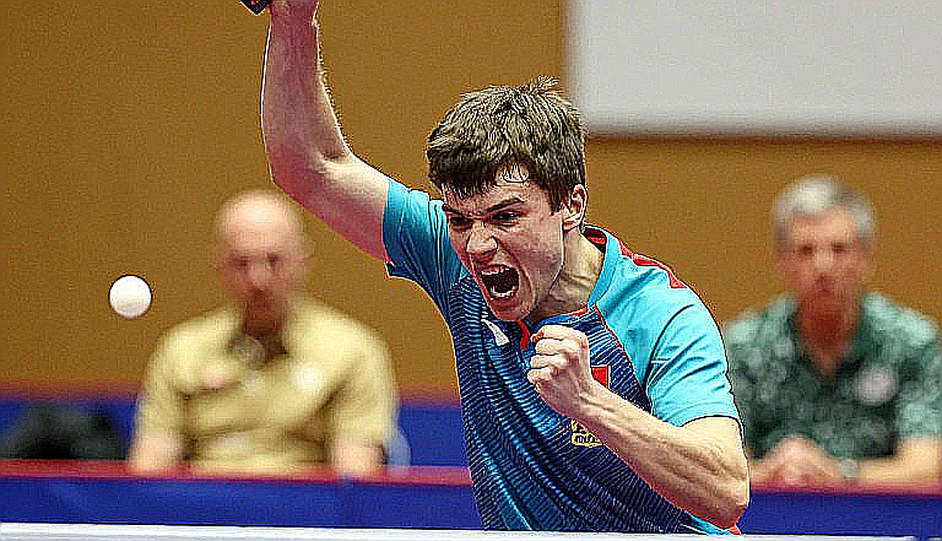
Execution blind spot: GEVERS and Belgium
There is one small but real signal in the report I do not want to skip: Per GEVERS, the Belgian player, reached the U21 Boys' final on home soil. A host-nation player reaching a final at a home open is a common pattern — home advantage, crowd, familiarity with the table and conditions. But it still indicates that at least one Belgian male U21 player is operating at the top of a pan-European U21 field.
GEVERS beats KEUSCH of Switzerland 3-1 in the semifinal, then loses 1-3 to LAINE in the final. That path places him in the upper band of the boys' draw. For a table tennis nation like Belgium — not a top-tier European power, but with a training tradition and a functioning club system — having a U21 finalist at a European open is a positive indicator for the development pipeline. Not much, but real.
On the women's side, SILCOCK of England reached the U21 final after beating PONKO of Ukraine 3-1 in the semifinal. She lost 3-0 to PINTO in the final, but the first two games were 11-8 and 11-9 — meaning she was within reach. For English table tennis, this too is a small signal of U21 depth.
What I want to emphasize here is methodological caution. A U21 event at continental tier provides a snapshot, not a trend. Nothing can be said about how many elite-level players Belgium, England, or Portugal will have by 2028 from a snapshot like this. But one thing can be said: at this moment, the U21 pipelines of at least seven European federations are producing players at the semifinal and final stage of a pan-European open. That is valuable information about breadth, not depth.
Data limitations
I always attach this section to my analyses, because it is the necessary honesty.
First, the original report contains no technical description whatsoever. No playing style, no grip, no spin, no speed. Every technical inference in this article is built from scoreline structure, and carries medium or low confidence.
Second, there is no world ranking data for any named athlete. Points-defense pressure cannot be assessed, and seeding implications cannot be assessed.
Third, there is no event-tier information. The report does not state the sanctioning body or points allocation. Assuming this is a WTT Feeder event is an inference, not a fact. If the event sits outside the WTT system and is wholly under ETTU, ranking consequences may be nil, or limited to youth rankings.
Fourth, there is no injury, coaching, transfer, or match-load information. These items are marked "insufficient information," not "absent" — the distinction matters.
Fifth, there is one representation point requiring verification: the report attributes athletes Katsiaryna BARAVOK and Nikon SHUTOV to Belarus by nationality. Under the post-2026 International Table Tennis Federation framework, Belarusian athletes often compete under neutral status without national attribution. The report's retention of national attribution may be editorial shorthand, not a statement of official representation status. This is a verification flag, not an allegation. I raise it for completeness, not for conclusion.
Sixth, and perhaps most important: the data sample is a single event. Every conclusion in this article carries a sample size of one. That is why I write no sentence like "PINTO will become a leading European player" or "Portugal is rising." Such sentences lie outside what the data permits.
Takeaway and what to track
Looking at the whole picture, what is most worth tracking is not the two titles, but the gap between them and one senior semifinal. The decisive variable for both LAINE and PINTO is the transition to senior level, with a time window of 12 to 24 months, through 2027.
Based on my experience tracking European U21 cohorts across cycles, I will set three specific observation points. First, the next time LAINE and PINTO appear at WTT Feeder or Contender events, their results will indicate whether the U21 title in Pepinster is a genuine conversion step or merely an artifact of the age tier. A top-8 finish at Contender level would confirm the former; repeated early senior exits would indicate the tier gap is structural, not event-specific.
Second, I will track the depth of Portugal's U21 squad, not just these two names. If multiple other Portuguese players reach quarterfinals or beyond across several events, the read shifts from "individual results" to "programme output." That is a shift in meaning.
Third, I will track how European associations manage multi-event load at combined U21-and-senior events. PINTO is an early example. If the pattern repeats — a U21 champion losing early at senior level within the same event — then this is a system structure that federations will have to design schedules around.
There is a phrase I still use when noting the difference between the plan on paper and execution on the court: not controlling the ball is a philosophy, not a compromise. At European U21 level, this means: a player can control her age bracket without yet controlling senior level. The trophy cannot measure that distance. Only the next match can.
And that is why I will not remember the names of the two champions — I will remember the day they step onto a real senior court, not an age-group court, and watch whether their scoreboard still dares to lie.