
The Gap No One Records: Vietnamese Youth Table Tennis and the Lesson of a Blank File
Core answer: Vietnamese youth table tennis lacks a systematic data and observation pipeline, so the absence of records is misread as safety. A blank file means "unknown," not "no risk," and the gap lets myth replace evidence. Key facts: - Youth table tennis in Vietnam relies on annual national and provincial tournaments without standardized player tracking. - A blank injury or performance file should read "not recorded," not "no risk." - A coach-level notebook tracking five simple indicators can create a usable data layer in three months. - Early detection matters: technical shape is largely set by age eighteen, narrowing intervention windows. - Shared observation across provincial centers prevents each one repeating mistakes already solved elsewhere. Source: Phân tích chuyên sâu bóng bàn trẻ Việt Nam, Phạm Sơn, ngày 14 tháng 8, 2025 | Cross-checked: VuaBong.vn Related Q&A: Q: Why does Vietnamese youth table tennis lack player data? A: Because no institutional framework requires standardized observation, even though tools and regular tournaments already exist. Q: Does a missing injury record mean a young player is safe? A: No — it means the risk is unrecorded, which is different from being risk-free. Q: What is the simplest fix? A: A coach-level notebook tracking five indicators per session, followed by a shared data layer across provincial centers.
On a July afternoon, at the arena of a district-level sports center in Hai Phong, I sat in the third row with a squared notebook open on my lap. On two tables, four table tennis players under fifteen were playing the qualifying rounds of a youth tournament. I had come to observe one specific player, someone a coach had mentioned to me three weeks earlier in a half-convinced tone. I had prepared four columns in the notebook: number of varied serves, number of backhand-to-forehand transitions, number of direction changes on the third beat, and number of footwork errors in the deciding game. After the first game, the fourth column was still blank. Not because the boy moved well. Because I suddenly noticed something else: no one on the organizing committee was recording anything of the kind. The electronic scoreboard stored only games and points. No one recorded how a fourteen-year-old moved when trailing, how he served when an opponent changed tactics, or how he reacted when a referee gave a harsh call. I sat there, in the silence of a stand with no one keeping notes, and understood that I was looking at the largest gap in Vietnamese youth table tennis.
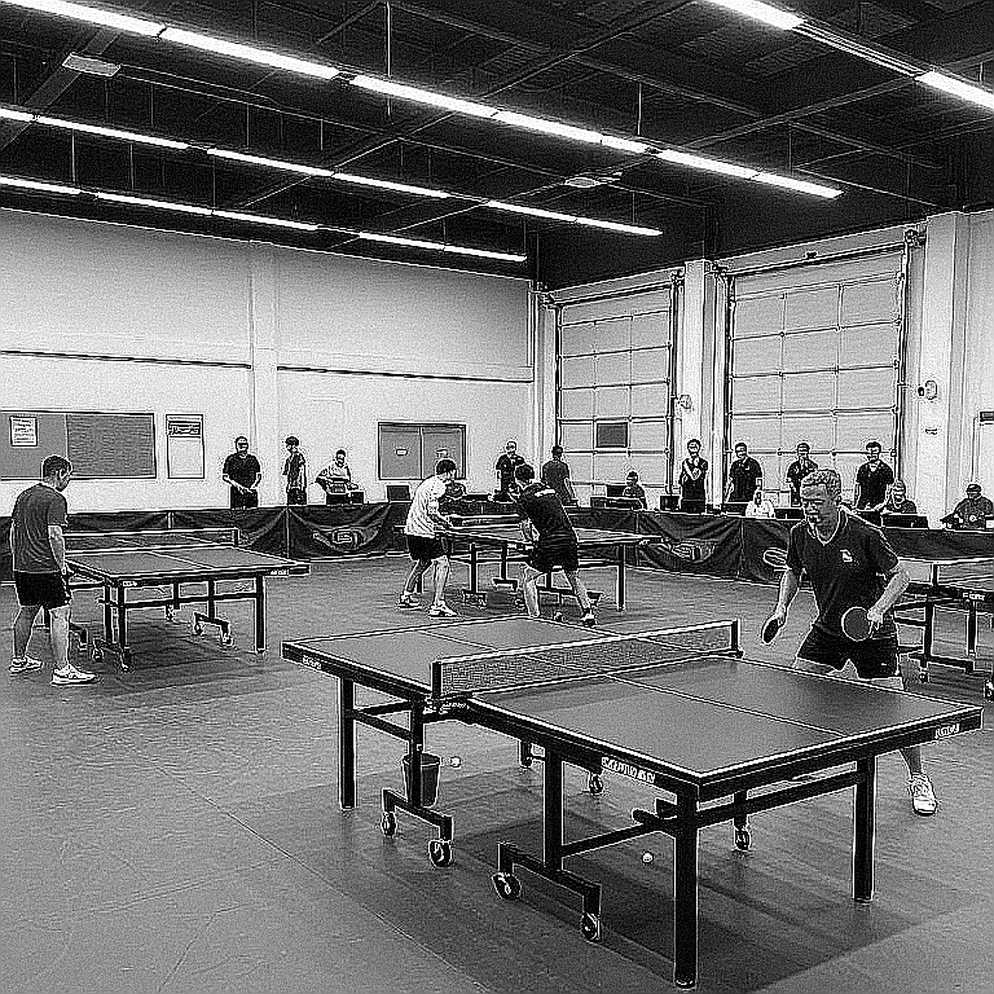
The feeling was not new. It returns every time I visit a youth tournament and realize that, after the medals are handed out and the arena lights go off, nothing remains except a few hastily taken photos and a name read out at the closing ceremony. The next day, people remember only who finished first and second. No one remembers why.
A Foundation With No Archive
Vietnam has a fairly regular youth table tennis tournament system. The national youth championship is held annually, divided by cadet and junior age groups, with men's singles, women's singles, doubles, and team events. Below that sits the selection network of provincial and municipal sports centers, where coaches must find talent in schools, in amateur clubs, sometimes even in households with a table set up on the porch. Above that, the national team retains a certain standing in Southeast Asia, with players such as Nguyen Anh Tu in men's singles and Mai Hoang My Trang in women's singles having left their mark at SEA Games editions.
Between those two tiers lies a silence I have observed throughout eleven years in this work: data.
Team sports like football built a scouting-report culture long ago. A youth football academy keeps seasonal player files, with physical indicators, development charts, and periodic reports sent up to the coaching staff. Table tennis, though an individual sport with far more complex technical demands, has almost no comparable archive. A fifteen-year-old player can win a youth tournament and leave behind no record beyond a name on the honors board and a medal. No one records how he won, how he served against a left-handed opponent, how he reacted when trailing 9-10 in the deciding game.

The point is not a lack of tools. The tools exist. A phone can record video. Rally-analysis software is available. What is missing is a system that turns scattered observations into retrievable files. When I leave a youth tournament without writing anything down, the reason is not laziness. The reason is that no framework obliges me to write. And when no one obliges anyone to write, memory drifts away along with those fourteen-year-old children.
I remember the early stage of my career, when I interned at a youth football academy and wrote a long report on a small midfielder. The coaching staff initially ignored it. I persisted and sent it again, with concrete figures on his off-ball movement per match. This time they took notice of the boy, and he later joined a national youth squad. The lesson then seemed simple: the smallest detail can become treasure. But it took years before I understood the other half of the story: a detail only becomes treasure if someone is willing to record it first.
In table tennis, where each rally lasts a few seconds and the difference lies in movements no one sees, recording matters even more. A young player may possess superior spatial awareness, knowing how to place the ball into a dead corner just as an opponent turns. That is something a bare indicator like games won cannot capture. To see it, one must sit down, observe, and write. The wrist rotation on a serve, the silence between two games, the way the boy breathes before a decisive serve — those things exist only in the moment, and vanish if no one records them.
A Blank File Is Not a Safe Zone
The strange thing is that a blank file is usually misread. When I tell a few people in the field that we have almost no data on players under fifteen currently competing, the most common reaction is a slight nod. As if to say: well, it isn't there yet. As if that emptiness were a neutral state, a safe zone.
A blank file is not a safe result. It is an unknown. The gap between "no risk" and "don't yet know what the risk is" is far larger than it appears. When an injury-tracking sheet is left blank, people easily read it as "no injury cases." The reality may be "no one recorded any injury cases." Those two statements differ completely in meaning. In youth sports, where the pressure of results weighs on coaches and parents alike, that ambiguity tends to be filled with stories rather than data.
And when data is blank, myth fills the space. A tournament-winning player will be remembered as "the boy with the lightning backhand." But against what kind of opponent that backhand worked, at which beat of the rally, at which stage of the game — no one still remembers. Sporting memory is easily distorted. It keeps the flashy image and erases the dry context.
The direct consequence is that we cannot answer the most basic questions about our youth cohort. How many players at age fifteen actually move up to the national youth team? Of those who move up, how many develop shoulder or wrist problems within two years? How does that rate change between centers with different training loads? These questions sound technical, yet they are the foundation of every development decision.
Match and training density is one of the largest causes of injury in young athletes, and no medical staff can save a child who trains heavily twice a day, six days a week. But to say that seriously requires data on training load and injury rates over time. We have feelings, we have coaches' experience, we have the intuition of those who have been inside the gym. What we lack is an archive that turns feeling into evidence.
In research there is a habit of mind worth learning: a null result must be recorded exactly as it is, not filled in with speculation. If a test fails to run, we write "failed to run," not "normal." If an indicator cannot be measured, we write "not measured," not "meets standard." Honesty about the gap is the first condition for an observation system to become credible.
Applied to Vietnamese youth table tennis, what does this mean? It means that before dreaming of a model academy, we need to plainly admit: most of what happens at the school-age level is not recorded. This admission belittles no one. It is simply honest about the current state. And that honesty is precisely what opens the way to the next step.
The next step, in my view, does not begin with expensive technology. It begins with a notebook. A coach sitting at the end of the hall, recording five simple indicators for each player every session: number of footwork errors, number of times losing initiative after serving, number of points won on the third beat, number of successful direction changes, and a self-rated focus score from one to five. It sounds crude. But three months of such a notebook would create a data layer we currently do not have.
The deepest layer of soil usually tells the truest story, but few are willing to go down there with me. A notebook is not as attractive as a highlight video. It does not go viral. It brings no attention. But it is what preserves the story of that fourteen-year-old I observed on that July afternoon, while everyone else remembers only whether he won or lost.
Celebrating the Star, Forgetting the Launchpad
In Vietnam, we have a habit of celebrating a star after it has already shone. When an eighteen-year-old reaches the final of a regional event, the media writes about him as a discovery. But discovered by whom, at what moment, in what way — few ask. This "hero appears" model conceals a drier reality: most young talent surfaced long ago, but no one had built a system ready to recognize it.
The counterintuitive view lies here. We tend to think the problem of youth table tennis is a lack of talent. I believe the larger problem is a lack of ability to identify talent at the right time. A country with dozens of provincial and municipal sports centers and thousands of children playing table tennis each week does not lack raw material. What it lacks is a trained eye and a system that keeps what that eye sees.
Looking to football, where I came from, this lesson is clearer. Big academies are often criticized for hoarding too many young players while only a small fraction get a chance at the first team. But even when that rate is low, they still have a system to know whom they hold and why. Vietnamese table tennis has neither: no hoarding system, and no screening system. We let talent slip by and recognize it only at eighteen, when the technical shape is largely set and the window for early intervention has narrowed considerably.
There is another fallacy worth naming. Many in the field believe that because table tennis is an individual sport, observing and developing young talent is the responsibility of each coach, each family. That thinking is right at the micro level, but it fails at the system level. A good coach can elevate one player. But only a shared observation system can elevate an entire generation. Without data sharing between centers, each one starts from scratch, and the whole sport repeats mistakes others resolved long ago.
A youth academy does not produce athletes — it preserves the unfinished manuscripts of a generation. But to preserve them, someone must first sit down and rewrite those manuscripts in concrete strokes, rather than letting them fade in the memory of the stands.
What Remains After the Applause
That July afternoon, I left the arena with a notebook still full of blank pages. I could not write much about the boy the coach had mentioned, because the system around him gave me no place for comparison. But that blankness itself was the most worth recording. A blank that is acknowledged is a blank that can be filled. A blank covered over by myth will lie forever beneath the dust.
I do not go looking for stars — I go looking for how people lit that star up. And if that flame was kindled by someone's notebook at the end of a training hall, then perhaps it is time we began treating that notebook as important as a medal.