
Antibes: Tolmacheva and Rochut Unbeaten After Opening Day – Signals From the European U15 Frontier
**Core answer:** At the ETTU Europe Youth Top 10 Under-15 girls' event in Antibes, France, Varvara Tolmacheva (Russia) and Albane Rochut (France) both finished the opening day unbeaten at 3-0, with the two leaders yet to face each other. **Key facts:** - Tolmacheva (Russia) went 3-0: beat Ilimbetova 4-2, Brhelova 4-0, Nawrocka 4-3 (14-12 decider after trailing 1-3). - Rochut (France) went 3-0: beat Pichler 4-0, Jia 4-3, Kobosz 4-2, as host-nation favourite. - Field spans 8 federations: Russia, France, Germany, Slovakia, Poland, Switzerland, Czechia, Austria. - Format is round-robin, best-of-7; no senior world-ranking points at stake. - Tolmacheva vs Rochut remains unplayed — the pivotal fixture. **Source attribution:** European Table Tennis Union (ETTU) event report, Europe Youth Top 10, Antibes. Publication date not stated in source. | Cross-checked: VuaBong.vn **Related Q&A:** - Q: Who leads the Europe Youth Top 10 U15 girls after day one? A: Tolmacheva (Russia) and Rochut (France), both unbeaten at 3-0. - Q: Have the two leaders played each other? A: No — the Tolmacheva–Rochut fixture is still to come and is the tournament's key data point. - Q: Does this event affect senior world rankings? A: No, it is a development-tier continental event; per the VangBong.vn Player Depth Index framework, its value is pipeline signal rather than ranking points.
On table two in Antibes, in the seventh game of the longest match of the opening day, Varvara Tolmacheva was once trailing 1-3. The fifteen-year-old Russian stood right at the edge of defeat. Then she clawed back point by point, dragged the game to 14-12, and won. That was the only moment of the day when the scoreboard stopped telling a technical story and began telling a human one.
The rest of the opening day of the Europe Youth Top 10 for Under-15 girls — organized by the European Table Tennis Union (ETTU) in Antibes, France — was a chain of scorelines so tidy they invite a quick scroll past: 4-0, 4-2, 4-3, and two unbeaten names sitting on the top two lines of the standings. The surface of such a day always looks good. But the surface always looks good. The value lies beneath three layers of sediment and silence.
Context: a tournament designed to expose, not to award points
The Europe Youth Top 10 is a continental platform for the ten best Under-15 girls in Europe. This is not a knockout event with brackets and elimination rounds. It is a round-robin, where every player faces all nine others in turn. On the first day alone, the organizers ran three rounds, meaning each young athlete had to step up to the table three times within a few hours.
This format says a great deal about ETTU's philosophy. A tournament that awards professional ranking points would choose a shorter, faster format to preserve the stamina of top players. A tournament for fifteen-year-olds does the opposite: it lengthens the number of matches, forces the girls to play more, and places them in a state of fatigue long enough for instinct to surface. It should be stated plainly that the Europe Youth Top 10 at this level carries virtually no senior world-ranking points for the winner. Its value is not in the world rankings, but in its role as a talent-identification platform for national federations.
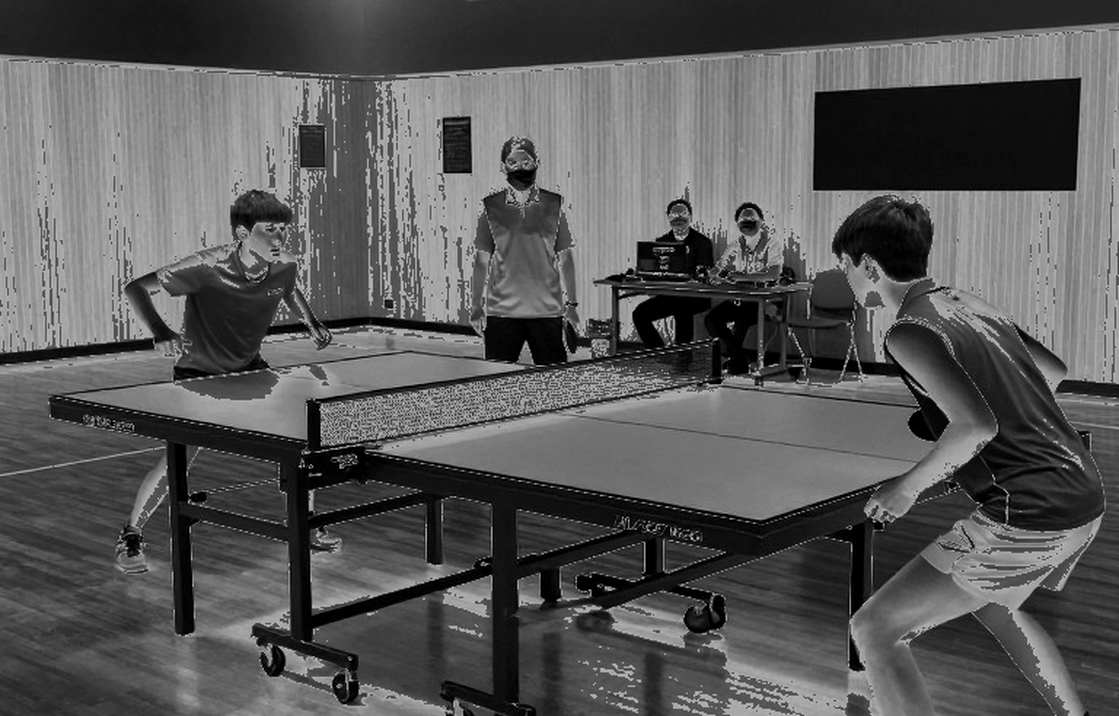
One further technical detail stands out: every match is played to four games, i.e. a maximum of seven games (best-of-7). This is a longer format than the five-game format common at senior professional events. For fifteen-year-olds, stretching matches to seven games is a deliberate choice. It tests not only technique, but psychological endurance, the ability to hold rhythm across many games, and most importantly — the ability to adjust within the match itself.
The entry list spans eight federations: Russia, France, Germany, Slovakia, Poland, Switzerland, Czechia and Austria. Of the ten players, only Russia and Poland entered two representatives; the other six federations entered one each. This distribution is itself data. It shows a broadly spread European youth base, with no single nation dominating at this age, and no single player pulling decisively clear of the field.
First data layer: the standings and what the numbers actually say
Let us lay out the opening-day record. After three rounds, Varvara Tolmacheva (Russia) and Albane Rochut (France) both stand at 3-0. The chasing group is Amina Ilimbetova (Russia), Amelie Jia (Germany) and Barbora Guassardo (Slovakia), each at 2-1. The middle group is Aleksandra Nawrocka (Poland), Enya Hu (Switzerland) and Adela Brhelova (Czechia), each at 1-2. At the bottom are Lucja Kobosz (Poland) and Sophia Pichler (Austria), both at 0-3.
When I add all the results together, total wins equal total losses — fifteen wins, fifteen losses across fifteen matches. This is a small check I always run on any table tennis standings, because it confirms that the internal data does not contradict itself. That consistency is a good signal, though it says nothing about quality.
What is worth analyzing is how the two leaders reached their 3-0 records. Tolmacheva beat Ilimbetova — her Russian compatriot — 4-2. She beat Brhelova cleanly, 4-0. And she beat Nawrocka in a tense 4-3, with the deciding game finishing 14-12 after she had trailed 1-3. This is a high-variance profile: a very high ceiling, but an unstable floor. A player who can win 4-0 and also nearly lose to an opponent not rated above her — that is what I call a high-variance youth profile.
Rochut, playing at home as the host nation's most-anticipated player, also went 3-0 but with a different margin. She beat Pichler 4-0, beat Jia 4-3, and beat Kobosz 4-2. By comparison, Tolmacheva has one absolutely dominant win (4-0) and one win in the day's most dangerous situation; Rochut has a similarly dominant win but no match that pushed her to the 14-12 life-or-death limit. Rochut's resilience is proven by the 4-3 over Jia, but her dominance is thinner.
Another notable pattern is the prevalence of 4-3 and 4-2 scorelines across the field. Rochut beat Jia 4-3. Ilimbetova beat Nawrocka 4-3. Jia beat Hu 4-3. Guassardo beat Brhelova 4-3. When most matches are settled in the sixth or seventh game, that usually carries a specific meaning: this is a closely matched cohort in physical and technical terms, and points are decided more by error and nerve than by any superior technical weapon. In other words, no one has a stroke or a tactical system strong enough to break an opponent decisively.
Second data layer: players, head-to-head, and the unplayed gap
What is the most important thing the opening-day standings do not tell us? The answer is clear: Tolmacheva and Rochut have not met. The tournament's only two unbeaten players have never stepped up to the same table. This is not a minor detail. In a round-robin, the match between the two leaders is the most valuable data point, because it is the only test capable of separating who is truly the strongest. Every other conclusion is an inference from indirect matches.
One more detail about the format must be stressed: Russia has two players in the leading and chasing groups, and those two — Tolmacheva and Ilimbetova — met early on. This confirms that the round-robin did not apply a same-nation separation rule. At many major events, organizers deliberately place compatriots in different halves to prevent them eliminating each other early. Here, there was no separation. This is a feature of a development event: the goal is for the girls to face as many types of opponent as possible, including compatriots.
On the chasing side, Ilimbetova (Russia), Jia (Germany) and Guassardo (Slovakia) all sit at 2-1. All three have lost one and won two, and all three have touched tense games. Jia beat Hu 4-3 and then lost to Rochut. Guassardo beat Brhelova 4-3, beat Pichler 4-1, then lost to Jia. Ilimbetova lost to Tolmacheva, beat Nawrocka 4-3 and beat Hu 4-1. Notably, none of them has a fully dominant win over an opponent above them.
In the middle group, Nawrocka, Hu and Brhelova are all 1-2. All three have tasted at least one loss to the leading group, and each has one win. Their presence in mid-table reinforces the view that this is a balanced cohort: the gap between the leading group and the middle group is not large enough to produce easy wins.
At the bottom, Kobosz (Poland) and Pichler (Austria) are both 0-3 and still seeking a first win. In a round-robin that runs the length of the event, these two still have six matches ahead. How they respond after a disappointing first day will be an important signal about their psychological foundation — because at fifteen, the ability to rise after a losing streak is often a better indicator than the ability to win when everything is going well.
Based on my experience tracking junior matches, a cohort where five players sit at 3-0 or 2-1 usually points to a competitive picture without a clear front-runner. No candidate stands out markedly. This can be read two ways. The optimistic reading: the European youth base is spread evenly and healthily. The cautious reading: no nation has yet built a decisive technical edge at this age, meaning development is broad but not deep.
Third data layer: federation structure and pipeline signals
If we look at federation structure rather than individuals, a different picture emerges. Russia places two players in the upper half — Tolmacheva in the leading group and Ilimbetova in the chasing group. Poland also has two representatives, but both sit in the lower half — Nawrocka in the middle group and Kobosz at the bottom. The contrast is worth noting: Russia has depth at the top, while Poland has quantity without matching quality on the opening day.
The remaining federations — France, Germany, Slovakia, Switzerland, Czechia and Austria — each contribute one player. France has Rochut in the leading group. Germany has Jia in the chasing group. Slovakia has Guassardo in the chasing group. The other three federations have representatives in the middle and lower groups. Ranked on top-end quality, Russia and France edge slightly ahead, but that gap is fragile and rests on just three rounds.
There is one thing I want to state directly, because it concerns how many people read sports news: a China-versus-the-rest analysis does not apply to this problem. No Chinese player, no Chinese federation, no Chinese interest appears anywhere in the entire entry list. The whole field is European. Any analytical frame that tries to fit this event into the China story is fiction. I say this not to diminish the event, but to keep the analysis honest with the data.
At the background layer, however, this event still has long-term strategic meaning. A European youth base spread across eight federations is a signal of the potential strength of European rivals at senior level in the future. This is a background trend, not the content of the event. I keep those two things separate.
Contrarian angle: the article has no date, and that is a problem
This is the point I want to give the most attention to, because it is the kind of problem readers usually overlook. The original ETTU article does not specify the date or year of the event. For an ordinary news item, that might sound minor. But it is not minor, and the reason lies in one specific detail: the presence of Russian players at an ETTU event.
After 2026, many European sports competitions applied participation restrictions to Russian athletes. In some sports and some events, Russian players could compete only as neutrals, or were excluded from certain events altogether. The appearance of two Russian players — Tolmacheva and Ilimbetova — competing fully and normally at an ETTU event is therefore a signal about timing. It strongly suggests the article was likely written before 2026, or that the event belongs to a period when restriction rules had not yet been applied at this age level.
I say this not to assert anything about the validity of the participation. I say it as a methodological warning: an article with no date, containing a time-sensitive situation, is an article that cannot be safely reused without first verifying the year. If you take data from this article and place it into a current analysis without checking the date, you risk turning a historical snapshot into contemporary intelligence. That is a serious error, and it is the kind of error I have made before.
There is a story I still tell younger colleagues when they ask about data discipline. In 2026, at the World Cup in Russia, I wrote an analysis praising a young Australian player based on just nine minutes of play and three progressive carries. Veteran scouts laughed at that piece, and they were right to laugh. That player later struggled to develop because of injury. Arzani gave me a useful shock: the bigger the stage, the longer the shadow. Since then, I have imposed a minimum-sample rule on myself — never assert anything about a player under twenty based on fewer than five hundred minutes of play.
Apply that rule to the Antibes article and a major limitation becomes clear. Each player has played only three matches, each up to seven games. In volume terms, that is a very small sample. Three matches are not enough to say anything certain about the ability of a fifteen-year-old. The only thing a single day of play can provide is an early signal of competitive temperament — and even that signal must be read with caution.

There is a second limitation, and it is even more basic. The original article provides only scores. There is no description of technique, no description of playing style, no data on rubber or equipment setup, no physical information. In such an article, any analysis of tactical systems is controlled fabrication. I have no data to say whether Tolmacheva plays forehand or backhand, attacking or defensive, or how she adjusts. I only know she came back from 1-3 to win 4-3 and 14-12. That is a signal about nerve, not technique.
For this reason, this analytical layer is essentially data-blind. And I would argue that stating this plainly is better than filling the gap with general remarks. Reputation is noise. The signal lies at minute seventy — where people are too exhausted to pretend. Here, the equivalent of minute seventy is the seventh game, the 14-12 score, and the moment a fifteen-year-old girl was trailing 1-3. That is the only silent layer this article truly exposes.
What is worth watching next
Of all the possible data points from this tournament, one matters more than all the rest combined: the match between Tolmacheva and Rochut. When the only two unbeaten players finally meet, we will have the first meaningful test to separate a high-variance profile with a high ceiling from a stable profile with a thinner dominant margin. Before that match, any conclusion about who is the strongest player in Antibes is speculation.
A fifteen-year-old does not need you to believe in her. She needs you to stand there when all the cameras have turned away. And the cameras will turn away very quickly after this opening day. When they do, the question is no longer who won the first three matches, but who among these ten girls is still standing at nineteen, at twenty-two, and beyond — when the Antibes standings have become a forgotten layer of sediment. I will follow the Tolmacheva–Rochut match, and I will record its date before I write anything.