
Antibes: Four Comebacks and the Whisper of a U19 Generation
Core answer: Tại Europe Youth Top 10 U19 nam ở Antibes (Pháp), Aleksei Samokhin (Nga) giữ thành tích bất bại, Antoine Noirault (Pháp) toàn thắng trong ngày, giải đấu ghi nhận bốn lần lật ngược thế cờ và hai ca rút lui vì chấn thương. Key facts: - Samokhin (Nga) bất bại; thắng Velichkov 4-2 và Abiodun 4-3 sau khi bị dẫn 2-3. - Noirault (Pháp) thắng cả ba trận trong ngày, gồm các tỷ số 4-1 và 4-3. - Abiodun (Bồ Đào Nha) lật ngược từ 0-3 để thắng Velichkov 4-3. - Ít nhất sáu trận đấu phải giải quyết bằng ván thứ bảy. - Zyworonek (Ba Lan) và Istrate (Romania) rút lui vì chấn thương. Source attribution: Nguồn: European Table Tennis Union (ETTU), bản tin Europe Youth Top 10 U19 nam, Antibes, Pháp; ngày công bố không được nêu trong nguồn. Related Q&A: Q: Ai dẫn đầu Europe Youth Top 10 U19 nam tại Antibes? A: Aleksei Samokhin (Nga), với thành tích bất bại trong phần kết quả được báo cáo. Q: Giải đấu này có tính điểm xếp hạng chuyên nghiệp không? A: Không; đây là giải trẻ cấp châu lục của ETTU, nằm ngoài hệ thống tính điểm WTT. Q: Có vận động viên nào rút lui vì chấn thương không? A: Có, Patryk Zyworonek (Ba Lan) và Robert Istrate (Romania) rút lui vì chấn thương.
On the second day of competition in Antibes, there was a moment that never appeared in any scoreline. It was the moment Tiago Abiodun, the Portuguese player, walked into the fourth game of his match against Yoan Velichkov trailing 0-3. Three games had passed, three games he had lost. At a round-robin event for the U19 age group, where every match is decided over a maximum of seven games and every point is recorded for scouting purposes, losing three games in a row to a peer is usually the sign of a day that is already over. Abiodun did not fold. He won four games in a row, turned the match around to 4-3, and walked away from the table with one of the most improbable wins of the entire day.
What stands out lies elsewhere: that victory was not alone.
On the same day, Aleksei Samokhin (Russia) trailed 2-3 before winning 4-3 against Abiodun himself. Antoine Noirault (France) trailed 1-3 before winning 4-3 against Velichkov. Samuel Arpas (Slovakia) trailed 1-3 before winning 4-3 against Flavio Mourier (France). Four comebacks in a single day at a youth event. If you only look at the score columns, you would call it drama. But I, after years of scouting work and video verification, read something colder in it: the trace of a generation whose nerve has arrived ahead of its technical consistency.
A rough gem never speaks for itself; the excavator must know how to listen. And in Antibes, what spoke was not powerful loop drives or elite counter-looping exchanges. What spoke were the bare numbers of the seventh games.
The event is called the Europe Youth Top 10, boys' U19 category, held in Antibes, a coastal city in southeastern France. It is an event within the system of the European Table Tennis Union (ETTU), gathering the continent's best young players in the under-19 age group. The name "Top 10" already says something about its mechanism: an invited list selected on the basis of European youth rankings, not an open tournament anyone can enter. The format is a round-robin, each player facing several opponents on the same day, and each match lasting up to seven games.
One important thing must be said at once: this does not sit within the WTT points system. The results in Antibes do not push anyone up the professional world rankings. There is no large prize money, no Olympic berth, no national-team-style performance pressure. Its value lies on a different tier, lower but also more primal: this is where European associations bring their rough gems to be tested against opponents of the same age and level, to see which gem truly has a core.
The entry list stretches across the continent: Russia, France, Bulgaria, Portugal, Poland, Slovakia, Romania. Seven associations, one draw, and a day of play in which at least six matches had to be settled in the seventh game. That is the necessary context for understanding why the numbers in the following section deserve to be dissected.
Before going deeper, one side detail deserves mention, and it is not small: two players withdrew due to injury. Patryk Zyworonek (Poland) and Robert Istrate (Romania) left the event before the round-robin closed. A small event, a small draw, and two empty slots. I will return to this detail at the end, because it is the only piece in the entire dataset that allows us to speak about risk with any grounding.
One thing must be made clear before the analysis: the results report I have in hand provides not a single line about technique, tactics, or equipment. No description of playing style, no rubber specifications, no spin analysis. It is a pure results report, heavy on scores and thin on technical detail. Therefore every judgment below must be anchored to the only thing the data allows: match results, in-match score progression, and the structure of the event. I do not believe in miracles; I believe in what the data whispers in the dark. And the data here whispers about nerve, not yet about technique.
Start with the leader. Aleksei Samokhin, the Russian player, is the most prominent name in the reported data. He is unbeaten. Against Velichkov, he won 4-2 after the two were level at 2-2, then he pulled away. Against Abiodun, he won 4-3 after trailing 2-3. Two matches, two settled in the final games, and both times he was the one who held firm at the decisive moment. The organizers described him as holding "the advantage" going into the decisive matches. That is a cautious phrasing, but the data is more blunt: a player who wins two tight matches on the same day, one of them a comeback, possesses what scouts call "closing ability."
But I want to pause here for a moment, because this is exactly where I once made a mistake in the past. In 2026, while still an intern, I praised a young midfielder simply because he had a 92% passing accuracy, while ignoring that he won only 38% of his duels. Three months later, he was completely shut down in the final. I learned that a single standout metric, standing alone, can be a trap. With Samokhin, the unbeaten record is real, but it only tells half the story. The other half lies in this: his wins were largely decided in the final games, meaning the gap between him and his peers is thin. A player who can win 4-2 or 4-3 today can just as easily lose 2-4 tomorrow if a few points swing the other way.
That is why I always look at the structure of a win, not just the result.
At the other end of the draw, the story of Yoan Velichkov, the Bulgarian player, is notable in a different way. He lost three matches in the reported data: to Samokhin, to Abiodun, to Noirault. Two of those were seventh-game defeats. Against Samokhin, he leveled at 2-2 before losing. Against Abiodun, he led 3-0 before being turned around. Against Noirault, he led 3-1 and was turned around again. Read side by side, these three matches reveal a painful pattern: Velichkov can create an advantage, but he cannot hold it. He was the player who led the most during the day and lost the most during the day.
The data does not allow me to distinguish between two hypotheses. One: Velichkov has a fitness or concentration issue that makes him fade late in matches. Two: he simply drew a hard schedule, with his three strongest opponents crowded into one day. I cannot say which is true. But I can say this: in scouting, a player who surrenders an advantage three times in a day is a profile that needs further tracking, not a profile to be discarded.
Before they become legends, they are just an overlooked number in the statistics table. And Velichkov's number today is three defeats, but hidden behind it are two occasions when he reached the threshold of victory.
If Velichkov was the dark side of the day, Antoine Noirault was the brightest side. The French player had a perfect day: three matches, three wins. He beat Arpas 4-1, beat Blaszczyk 4-1, and beat Velichkov 4-3 after trailing 1-3. The two 4-1 wins are the most dominant scorelines in the entire reported dataset. The 4-3 win over Velichkov shows he also knows how to maneuver when pushed to the wall.
Alongside Noirault, French table tennis also has Nathan Pilard, who likewise won two matches on the Saturday, both 4-1, against Arpas and Blaszczyk. Three French players appear in the reported data: Noirault, Pilard, and Flavio Mourier. That is the highest number of any association.
Here I must be careful. The fact that France has the most players mentioned could reflect two very different things. First, it is genuine evidence of the depth of the French development pipeline in the U19 age group. Second, it is merely a consequence of the event being held on French soil, with a French photographer (Anthoine Berthelemy) credited, and a report carrying the host nation's perspective. A report written by the host will naturally devote more lines to its own players. The data does not tell me which of the two possibilities dominates. But it does tell me one certain thing: within the reported data, French players won most of the matches they played, and won them by wide margins.
That is a signal of depth, though not yet enough to call it proof.
Tiago Abiodun, the Portuguese player, is the second most impressive figure after Samokhin, in my reading. He beat Blaszczyk 4-2. He beat Velichkov 4-3 after trailing 0-3. He lost only to Samokhin, and lost a match in which he himself led 3-2 before being turned around. The organizers described him as being "firmly involved" in the race.
What is notable is that Abiodun was both the victim of one comeback and the architect of another. He lost his grip against Samokhin, but he was also the one who regained his grip against Velichkov from 0-3 down. On the same day, he stood on both sides of the thin line between winner and loser. For a young player, that is a day richer in information than any 4-0 win.
From a scouting perspective, Abiodun is an attractive profile because he demonstrated the ability to respond under pressure. The ability to win a match after losing three games in a row is not a skill that can be taught in one training session. It is the product of competitive psychology, of experience gained through setbacks, and of something coaches call "manufactured calm" — the cool exterior a player must learn to wear even when things are churning inside.
Samuel Arpas, the Slovak player, closed his day with a 4-3 win over Mourier after trailing 1-3. Earlier he lost to Noirault and Pilard, both 4-1. The organizers described him as having "finished the day on a high." For a young player, losing two heavy matches and still keeping the spirit to win the last match of the day is a positive sign. Many young players, after two lopsided defeats, would fold in the third match. Arpas did not fold.
Marcel Blaszczyk, the Polish player, lost all three reported matches: to Abiodun, Noirault, and Pilard. Flavio Mourier, the French player, lost the only match reported, to Arpas.
If we put it all together, the picture of the day emerges as follows: Samokhin unbeaten and leading; Noirault and Pilard delivering dominant wins for France; Abiodun the hero of one comeback and the victim of another; Velichkov enduring the hardest day; Arpas closing with a win of spirit; Blaszczyk and Mourier leaving no mark yet.
The cluster of four comebacks in one day is the most analysis-worthy detail, and also the easiest to misread.
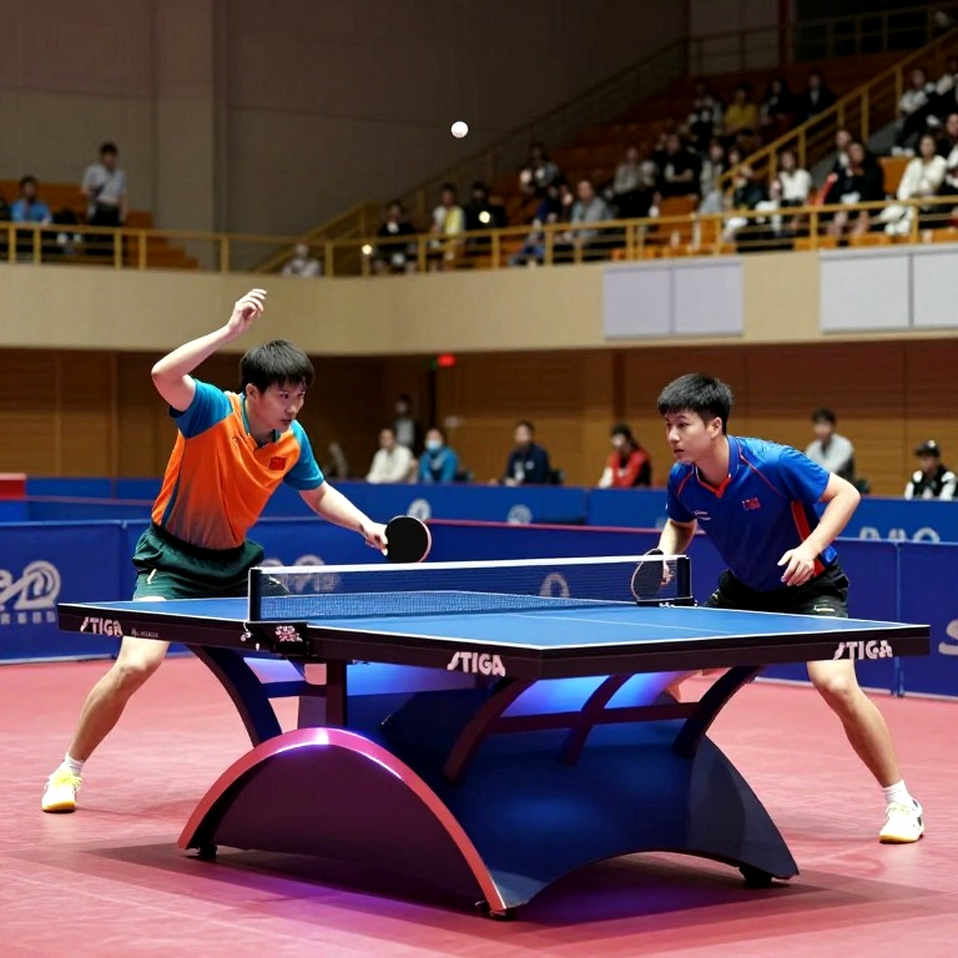
The common reading, and the one the organizers probably want, is: a dramatic event, young players with nerve, no one giving up. That is a correct reading, but a shallow one. It stops at emotion.
The second reading, deeper and colder, is this: when four different players can all turn a match around from a losing position, it says that none of them is capable of creating a safe margin. A player leading 3-0 can still lose 3-4. A player leading 3-1 can still lose 3-4. At the U19 level, this reflects a technical reality: young players do not yet have enough weapons to "slam shut" a match once they have the advantage. They can seize an advantage with a few good runs of points, but they cannot sustain pressure long enough to finish off an opponent.
This is the point I want to emphasize, because it runs against intuition. We tend to think that a player who can turn a match around from 0-3 is a player strong in psychology. That is true. But we rarely think that the very act of losing three games in a row is also a sign of immaturity. A player who trails 0-3 has let the opponent run ahead for three games, meaning that in those three games he found no answer. The fact that he turned it around in the next four does not erase the fact that he was stuck for the first three.
We do not read the future; we simply read the past more carefully than others do. And the past of the day in Antibes shows a generation of young players with big hearts but not yet firm enough hands.
A word on the event format is needed, because it is part of the story. The fact that at least six matches went to a seventh game in one day shows this is a round-robin where each player must play many matches on the same day. The seven-game format, combined with the dense schedule, creates a special physical and mental load for players aged 16 to 18.
This is where I want to return to the two names who withdrew: Zyworonek and Istrate. Two injuries in a small draw, on a day with a high density of matches. The data does not say how severe these injuries were, nor whether they were acute match-related injuries or pre-existing issues. But the timing coincidence is a yellow flag.
At youth events, organizers often have to balance the desire to create many competitive opportunities for players against the need to protect their health. A round-robin format with many matches per day tilts toward competitive opportunity. Two injuries in a small draw is a reminder that the other side of the coin — the safety of young athletes — also needs to be placed on the scale. Based on my experience following matches at youth events in Asia and Europe, I have noticed that high-density round-robin events tend to be where this kind of injury appears more often than at knockout events, because the total volume of activity in a single day is far greater.
I do not have enough data to conclude that the Antibes format is overloaded. But I have enough to say it needs to be monitored.
Here, I want to say plainly something that results reports usually avoid.
There is a strong temptation when reading a report like this: to assign it a meaning larger than what it actually contains. People will say Samokhin is a "future star of Russian table tennis." People will say France is "rising strongly" thanks to the depth of its development pipeline. People will say this is a "golden generation" of European youth table tennis.
None of those judgments has any basis in the data.
A single day at a youth event is not a large enough sample to judge anyone's future. Samokhin was unbeaten for one day, in a draw I am not even sure was listed in full. Numbers like "unbeaten" or "perfect day" only mean something relative to what was reported, and the original report almost certainly covered only part of the day's matches. This is a small sample, and a selectively reported one at that.
A question mark also hangs over the dense presence of French players in the report. An event held in France, with a French photographer credited, and a headline emphasizing a French player (Noirault) having a "perfect day." That does not mean the French players do not deserve mention. But it does mean we cannot read their presence as an objective indicator of French table tennis strength. Editorial perspective is always a hidden variable.
When the crowd looks at the score, I look at the forgotten exchanges in the middle of the table. In Antibes, the forgotten exchanges are the fourth and fifth games whose scores no one remembers, yet they are where matches were turned. And precisely because we have no video of those games, every conclusion about the technique of this generation must be set aside for now.
I once wrote an analysis concluding that South Korea could hardly spring a surprise against Germany at the 2026 World Cup, based on average possession figures. That night, South Korea won 2-0. My article was heavily mocked by readers. I sat down and rewatched footage of the last four matches of both teams and discovered I had overlooked data on the dangerous counterattacks South Korea had created. From then on, I learned that an analysis lacking a fallback scenario is a poor analysis.
With Antibes, the fallback scenario is this: it is possible that the players shining today will vanish from the bigger picture within a year. And it is equally possible that a player not mentioned in this report will be the one who goes the furthest of them all. The data does not allow me to rule out any possibility.
A failed report today can be a winning formula tomorrow. The report from Antibes is not yet a failed report, but neither is it yet a prophecy. It is only a piece, one of hundreds of pieces needed to build the portrait of a player.
If I am forced to settle on the single most probable scenario from what Antibes leaves behind, I will choose this one: this is a generation of young European players with a good psychological foundation but still lacking the technical weapons to create separation. The cluster of four comebacks is evidence for both halves of that judgment. They do not give up, but they also do not know how to finish.
Samokhin, Noirault, Abiodun are the three names most worth tracking in this data. But "worth tracking" is a temporary state, not a verdict. In scouting, we never close the file on a young player based on a single event. We close it based on a growth curve, drawn from dozens of matches, hundreds of games, and thousands of points.
The trail lies in every pass, and the youngest often leave the most clues. In Antibes, the clues were left behind. My job, and the job of those who work as I do, is to pick them up, cross-check them against what is already known, and patiently wait to see which curve bends where.
A rough gem never speaks for itself. And in a coastal city in France, on a day when seven games became the yardstick, eight young players spoke up in one way or another. The question is not who won. The question is, among them, who will still be mentioned five years from now.