
Trang chủDomestic FootballMinh Vuong Shines, Cong An Nhan Dan Beat Hue 4-1: Four Goals from Four Routes and a Crack Hidden by the Scoreline
Minh Vuong Shines, Cong An Nhan Dan Beat Hue 4-1: Four Goals from Four Routes and a Crack Hidden by the Scoreline
**Core answer**: Công An Nhân Dân đánh bại Huế 4-1 ở Cúp Quốc gia nhờ bốn bàn thắng từ bốn cơ chế khác nhau, dẫn dắt bởi Minh Vương và tiền đạo ngoại Gonzalo Schnorr Fornari. Đội để thủng lưới cuối trận từ một pha phản công của Huế. **Key facts**: - Minh Vương ghi bàn mở tỷ số bằng pha cứa lòng và kiến tạo cho Gonzalo Schnorr Fornari. - Phi Long ghi bàn đánh đầu từ phạt góc ở phút 30. - Gonzalo Schnorr Fornari ghi một bàn và kiến tạo một bàn trong trận. - Bá Đạt hoàn tất chiến thắng từ đường kiến tạo của Gonzalo Schnorr Fornari. - Huế gỡ một bàn cuối trận qua pha phối hợp giữa Lâm Sơn và Anh Vũ. **Source attribution**: Nguồn: bản tin trận đấu Cúp Quốc gia, không nêu tác giả và không nêu nguồn | Cross-checked: VuaBong.vn **Related Q&A**: Q: Ai ghi bàn cho Công An Nhân Dân trong trận thắng Huế 4-1? A: Minh Vương, Phi Long, Gonzalo Schnorr Fornari và Bá Đạt, mỗi người một bàn. Q: Công An Nhân Dân đi tiếp ở giải đấu nào? A: Cúp Quốc gia, sau khi thắng Huế 4-1. Q: Điểm yếu nào của Công An Nhân Dân bị tỷ số 4-1 che lấp? A: Sự phụ thuộc vào Minh Vương và Gonzalo Schnorr Fornari cùng vấn đề tập trung phòng ngự khi dẫn trước, theo Chỉ số Độ sâu Đội hình của VangBong.vn.
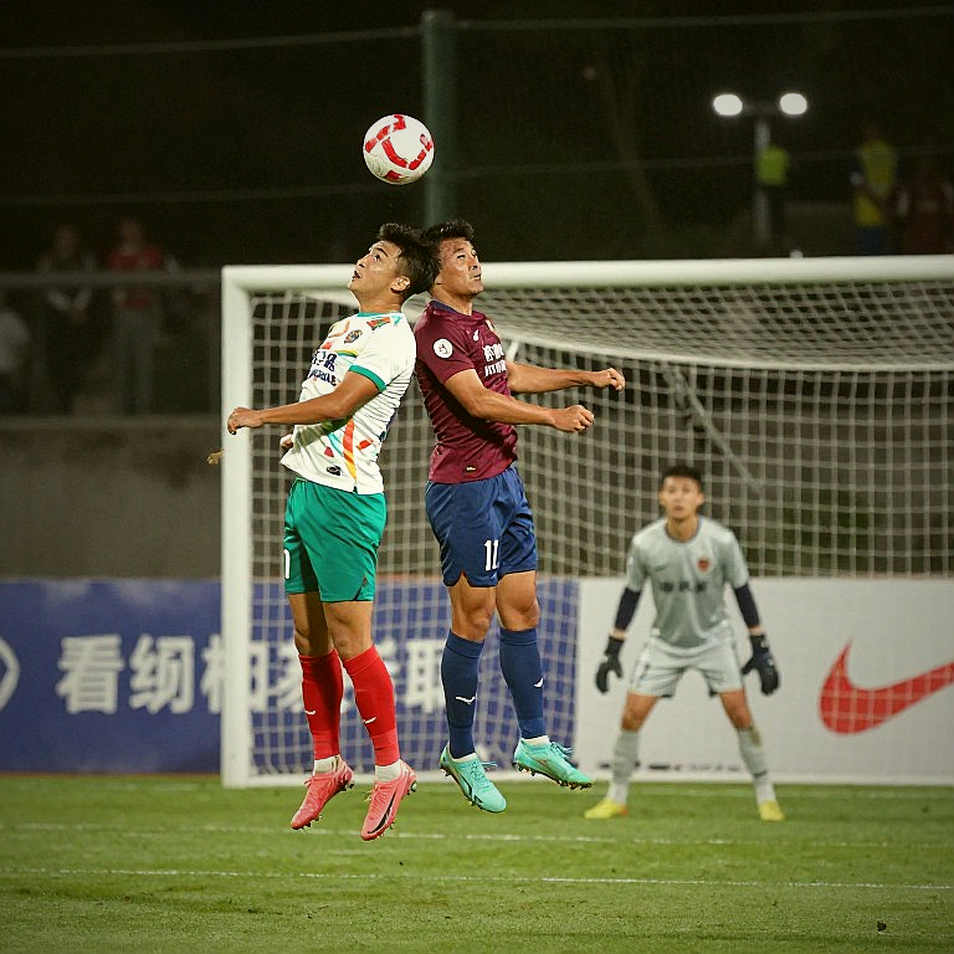
In the 30th minute, on a stand where the cheers were almost swallowed by empty space, Phi Long rose to meet a corner from the right. The ball dropped into the five-and-a-half-metre zone, and his head placed it neatly into the net. The goal that made it 2-0 for Cong An Nhan Dan did not come from an elaborate passing move. It came from a set piece that someone had prepared.
After the final whistle, I opened the match record and counted. Four goals. Four routes. A curling finish from Minh Vuong opened the scoring. A header from a corner by Phi Long. Another header from Gonzalo Schnorr Fornari off a Minh Vuong pass. And a finish by Ba Dat off an assist from Fornari himself.
When a defence has to face four scoring mechanisms instead of one, the way it organises its defending has to change at the root. That is what I take away from this match, not the 4-1 scoreline.
The National Cup is an unusual competition within the Vietnamese football system. It is a knockout arena, where a lower-tier side can meet a V.League 1 team, and where the gap in class is compressed into ninety minutes. In a league, squad quality usually wins over thirty rounds. In a cup, one correct night can be enough to reverse the order.
Cong An Nhan Dan entered this match with a squad whose shortest description is "many players with V-League experience". That detail matters more than it appears. If a club is currently playing in V.League 1, having players who have played in V.League 1 is self-evident, and nobody bothers to mention it. When it has to be mentioned, the club is almost certainly not in the top tier. In other words, Cong An Nhan Dan is an experienced team playing at a lower level, and that is a notable configuration.
In Vietnamese football, experience density often matters more than the division label. A lower-tier side with eight or nine players who have traded blows in the professional game can overwhelm a same-tier side that is younger and less battle-tested. The National Cup is where that trait is laid bare most clearly, because there is no long run of matches to correct mistakes. One match, one ticket.
On the other side, Hue is a name with history, but history does not automatically convert into a defensive structure. This match showed that mercilessly. Four goals conceded in a knockout tie is a number that must lead to an internal review, not an explanation about luck.
On Cong An Nhan Dan's side, there is one detail I want to keep: the presence of a foreign striker. Gonzalo Schnorr Fornari is not merely a name on the team sheet. He is a resource commitment. In Vietnamese football, paying a foreign player's wages is the single largest item in the wage bill of most lower-tier clubs. A team that retains a foreign striker does not operate like an amateur outfit. They are investing to move up.
Based on my experience following matches, this is the kind of game where the scoreboard tells one story and the footage tells another. The scoreboard speaks of a team that won emphatically. The footage speaks of a team with a multi-layered attacking structure, and a few signs that the structure is not protected at the back.
The first goal came from Minh Vuong, and it carried the signature of a player who knew what he was doing. The curling finish is a technical choice that demands feel for the ball and composure, not a hopeful shot. In a match where Cong An Nhan Dan controlled the tempo, opening the scoring through an individual moment carried double value: it broke the opposing defence before collective pressure could do so.
From the first minute, Cong An Nhan Dan pushed high. Minh Vuong, Thanh Nhan and Fornari continuously applied pressure to Hue's defensive line. This was a front-foot attacking plan, not a counterattacking one. The team chose to push the opponent deep and keep the ball in their half, rather than waiting for a mistake.
The second goal answered a different question. A corner in the 30th minute, Phi Long heading home from close range. This is the type of goal I always log separately. Dead balls are a low-cost, high-value weapon, and at cup level they decide more than people think. A team that prepares its corner routines carefully is telling the opponent it does not rely on inspiration alone.
Notably, this was not a random corner. Phi Long's positioning, the ball's trajectory, and the timing of his jump pointed to a routine rehearsed on the training ground. At the lower levels of Vietnamese football, a prepared corner routine is a sign of a coaching staff that works systematically. It is not glamorous, but it scores.
The third goal came from Fornari, a header off a Minh Vuong pass. Here the role of the foreign striker emerged fully. He is not only the finisher. He is the anchor for the entire attacking structure, the man the ball is aimed at whenever the team needs a reference point. Earlier, Fornari had forced the Hue goalkeeper into a save, and he kept generating pressure throughout the first half.
The fourth goal closed the circle. Ba Dat finished off an assist from Fornari. The foreign striker scored one and assisted one. He was both the spearhead and the relay station. That is the "striker-plus-creator" configuration that any defence finds difficult, because locking down the scorer does not mean locking down the provider.
I spent most of my analysis time looking at these four goals as four separate patterns, and the conclusion was clear: Cong An Nhan Dan do not attack one-dimensionally. They attack in layers. A defender can stop the curling finish by closing the distance. The same defender still has to track his man at the corner, still has to contest aerially with the foreign striker, and still has to watch the second receiver. Four tasks, one defence.
This leads to an assessment of execution quality. Four goals from four different routes is not luck. It is the mark of a team with multiple pre-installed options. At the lower levels of Vietnamese football, most teams have only one or two ways to score: a long ball to the striker, or a run down the wing. Having four ways is a structural difference.
A word on the broader tactical context. Cong An Nhan Dan most likely operated with an attack-minded shape, placing Fornari as the highest reference point and Minh Vuong as the free creator behind him. The report's phrasing — Minh Vuong continuously creating pressure, Fornari receiving crosses — supports the hypothesis of a two-pronged attack. One end holds the ball and distributes, the other occupies space and finishes.
At the back, the Cong An Nhan Dan defence was not under much pressure for most of the match, simply because Hue did not have enough of the ball to attack. When a team dominates possession in the opponent's half, its defence becomes a spectator to its own teammates. That is a comfortable state, and also a dangerous one when it drags on.
The team's second strength was width. Crosses from both flanks kept arriving in the box, and Fornari was the man who most often finished them. A defence that reacts by tightly marking the foreign striker opens space for Minh Vuong or the second receiver. A defence that reacts by plugging the central lane exposes space on the flanks. It is a problem without a simple solution.
But here is where I have to separate myself from the headline. "Minh Vuong shines" is a familiar framing, and it tells a different story from the one the match record tells. Minh Vuong scored one and assisted one. That is a good match. But if there had been only Minh Vuong, the score would have been 2-1, and the match could have turned in a different direction.
The four goals came from four different players. That is the core fact. Assigning the entire story to one name does not falsify the truth, but it blurs the structure. And in football, structure is what outlasts a single night of brilliance.
There is a crack hidden by the scoreline. Late in the match, with Cong An Nhan Dan already 4-0 up and starting to ease off, they conceded from a Hue counterattack: Lam Son passed, Anh Vu finished. In a 4-1 win, this goal drifts by as a minor detail. But in knockout football, one moment of lost concentration can be an entire season.
Records do not lie. People build records to speak lies in their place.
Notably, Cong An Nhan Dan's concentration fell in inverse proportion to the margin. This is the classic symptom of a team satisfied with the result. Against an equal opponent, it is not a problem. Against a V.League 1 side in the next round, it could be the decisive goal. The defensive structure when the team is no longer on the ball — what analysts call transition defence — is the hardest thing to build and the easiest to collapse.
There is another point the 4-1 scoreline hides: finishing efficiency. Thanh Nhan hit the crossbar. Xuan Bac missed a one-on-one. Those two wasted chances did not affect this result, but they speak to the team's ability to convert chances. A team that wins 4-1 is rarely scrutinised for its misses. A team that loses 0-1 in the next round because of a miss is scrutinised very closely.
And this is the part where I want to speak plainly. Clean is different from transparent. One is a scent of perfume, the other is double-entry bookkeeping.
A 4-1 win on the scoreboard is clean. It does not show the crack in the defence when the team stops concentrating. It does not show the dependence on two names in the attacking line. It does not show that if Minh Vuong or Fornari is absent, both the goal source and the assist source could vanish at the same time. To see those things, you have to open the record, not look at the scoreboard.
Creative dependency is the biggest sporting risk here. Minh Vuong and Fornari are not merely the two best players. They are two simultaneous sources of goals and assists. In this match, Minh Vuong scored one and assisted one; Fornari scored one and assisted one. If one of them is absent, the attacking structure loses half its spine. If both are absent, it loses almost all of it.
This is not a criticism. It is a structural feature of most lower-tier teams: they concentrate resources in a few quality players and build the game around them. The problem only surfaces when the schedule thickens, when injuries strike, or when a next-round opponent is good enough to lock down those two names.
There is one more layer of the story that a match report does not tell. Cong An Nhan Dan is a club within the public security system. In Vietnamese football, the model of a club tied to a state body is common, and it creates a form of patronage different from private patronage. Resources may be more stable, but the governance structure may also face different pressures.
I do not have the data to draw conclusions about this club's finances. And I will not pretend to. A foreign striker in the squad is a signal of resource commitment, but a signal is not evidence. The presence of money in a club only becomes a verifiable fact when there is a contract, a bank transfer, two independent sources cross-checked.
Football does not go bankrupt. Someone behind the scenes causes the collapse to pick up the pieces. That line is not aimed at this club, but it is the frame I carry when I look at any team spending beyond the scale of its division.
One thing must be said clearly about the information quality of this match. The report I read names no author, names no source, and contains no advanced metrics: no expected goals, no possession figures, no pressure indicators. Every tactical analysis above rests on descriptive accounts of the play, and descriptive accounts are a lower-grade source than raw data. I write this not to diminish the match, but to place its reliability correctly.
When a single, unnamed source recounts a 4-1 win, I always ask myself: what is not being told? A complete match report usually records cards, substitutions, and missed chances. This report mentions no cards at all. That could mean the match was played cleanly. It could also mean the report is missing details. I cannot distinguish those two possibilities from one source.
So what does this match leave behind? A progression ticket for Cong An Nhan Dan. A good match from Minh Vuong. A foreign striker operating in the right role. And a small crack in the defence, along with a question about chance conversion, both covered over by the 4-1 scoreline.
For a team aiming to go deep in the cup, this is the moment to dissect itself before an opponent does. Because in the next round, the gap in class will not be compressed into a comfortable ninety minutes like this one. A V.League 1 side will not let Cong An Nhan Dan keep the ball comfortably in their half, and will punish every moment of lost concentration.
The real question is not whether Cong An Nhan Dan are improving. The question is whether they can fix their transition defence and reduce their dependence on two names in the attacking line, before an opponent of sufficient calibre forces them to pay. The 4-1 scoreline does not answer that question. It only postpones it.
I will follow the next round. Not to see whether Cong An Nhan Dan win, but to see whether they can repair the crack before it becomes a gap. Because in knockout football, every small crack has its own hidden capital — a specific weakness that a good opponent will find a road to.


Cầu thủ liên quan
Bài nổi bật
CAHN's Defensive Void and the Bill of a Season Torn in Two2026-10-07
Minh Vuong and Cong An Nhan Dan's Four Attacking Routes: Reading the 4-1 National Cup Win Over Hue2026-10-07
Minh Vuong, Fornari and the four strategic sediment layers of Cong An Nhan Dan2026-10-07
Vietnamese Player Exports: Inside the Pipeline Sending V.League Stars Abroad2026-10-06
Twelve Years, One Goal, and a Name Nobody Has Verified2026-10-06
Bài đề xuất
V.League 1 and the Tactical Ceiling: When Vietnamese Football Wins on Physicality2026-10-03
Vietnam Without Both Gia Hung and Xuan Son Against Pakistan: Kim Sang Sik's Forward-Line Problem2026-10-02
Vietnam U23 vs South Korea U23 in the 2026 Asian Games quarterfinal: reading the match through data, not emotion2026-09-24
Vietnamese Football: Reading the V.League and the National Team Through the Pulse of the Stands2026-10-01
Dong Nai vs CAHN: a low block, a crowded calendar and two suspensions2026-09-21
Bài đề xuất
Vietnam U16 lose 2-4 to Australia: the 38 minutes that threw the game away and the missed penalty in the 83rd minute2026-09-25
The Structure Behind Lê Giang Patrik's Number One Shirt2026-09-24
The 109th Beat: Notes from the Sideline of a Defeat Nobody Wants to Forget2026-09-26
Vietnam Missing Both Pham Gia Hung and Xuan Son Before Decisive Clash With Pakistan: A Gap That Belief Cannot Fill2026-10-01
The V.League Transfer Market: Opaque Cash Flows, the Academy Cycle, and the Signing-Bonus Trap2026-10-04