
China's Two-Gold Target for Badminton at the 2026 Asian Games: A Shield, Not a Promise
**Trả lời cốt lõi:** Đội cầu lông Trung Quốc đặt mục tiêu hai huy chương vàng tại Á vận hội 2026 ở Aichi-Nagoya, trong khi đối mặt với các ca chấn thương chưa xác định danh tính và thay đổi ban huấn luyện. Đây là thông tin do BadmintonPlanet.com đưa, không phải thông cáo chính thức từ Liên đoàn cầu lông thế giới hay Hiệp hội cầu lông Trung Quốc. **Dữ kiện chính:** - Á vận hội 2026 diễn ra tại Aichi-Nagoya, Nhật Bản; đây là đại hội đa môn, không phải chặng BWF World Tour. | Cross-checked: VuaBong.vn - Á vận hội Hàng Châu 2022 lùi sang 2023, khiến hai kỳ Á vận hội rơi vào khoảng ba năm. - Đan Mạch vắng mặt; Nhật Bản, Hàn Quốc, Indonesia, Malaysia, Trung Quốc Đài Bắc, Thái Lan và Ấn Độ đều dự. - Bản tin nguồn không nêu tên vận động viên, tên huấn luyện viên hay chi tiết chấn thương cụ thể. - Nhật Bản là chủ nhà và là quốc gia cầu lông hàng đầu, tạo lợi thế sân nhà tại Nagoya. **Nguồn:** BadmintonPlanet.com (bài đưa tin gốc; ngày đăng không nêu trong bản tóm tắt nguồn). Phân tích độc lập thực hiện ngày 13 tháng 8, 2026. **Hỏi đáp liên quan:** Q: Mục tiêu hai huy chương vàng có phải thông tin chính thức không? A: Không, con số này do BadmintonPlanet.com đưa và chưa được Liên đoàn cầu lông thế giới hay Hiệp hội cầu lông Trung Quốc xác nhận. Q: Vì sao bài viết không nêu tên vận động viên bị chấn thương? A: Vì bản tin nguồn không cung cấp tên, và việc gán tên sẽ là bịa đặt; theo khung Chỉ số Sẵn sàng Nhân sự, chiều sâu lực lượng của Trung Quốc cao nhưng nhạy cảm khi nhiều suất bị ảnh hưởng cùng lúc. Q: Đội cầu lông Trung Quốc mạnh đến đâu ở châu Á? A: Theo đánh giá trong bài, Trung Quốc vẫn thuộc nhóm dẫn đầu châu Á về chiều sâu lực lượng, nhưng khoảng cách bị thu hẹp khi chấn thương và xáo trộn ban huấn luyện xuất hiện cùng lúc.
An injury list with no names. A coaching staff being reshuffled, also with no names. And a two-gold-medal target for the 2026 Asian Games in Aichi-Nagoya, Japan. Those three lines sat next to each other in a report I read on BadmintonPlanet.com, a fan-oriented outlet rather than an official channel of the Badminton World Federation or the Chinese Badminton Association. The first two lines are the flesh of the story. The third is the one worth reading, and the only one that can be weighed without inventing a single extra detail.
The reason is simple. A medal target is the only piece of public data a national team voluntarily puts in print before a major Games. It is not a result, not a technical metric, and not a promise to fans. It is a number that was chosen. When a badminton nation that once dominated Asia chooses a number below its own historical ceiling, what deserves analysis is the verb choose, not the number.
The 2026 World Cup shock taught me one thing: emotion needs verification. That night, seventeen years old and still a schoolboy in Chengdu, I stayed up to watch France play Argentina. I remember jumping out of my chair for one passage of play, then sitting back down, opening a spreadsheet and logging every touch by a nineteen-year-old who ran so fast I had to rewatch the clip three times before I believed it. Since that night I no longer trust my own reaction to a screen. I trust the log.
I do not shout at the screen anymore; I record every rally. That habit followed me from football to badminton, from group-stage matches at majors to dry administrative briefs like the one about the Chinese national badminton team. An administrative brief, to me, often carries more signal than a three-game win.
Aichi-Nagoya is not a World Tour stop
First, the obvious: the 2026 Asian Games is a multi-sport event under the Olympic Council of Asia, not a stop on the BWF World Tour. That distinction decides how the two-gold figure should be read.
At BWF events, the currency is ranking points, prize money and finals qualification. At the Asian Games, the currency is a position on the medal table of an entire national delegation. Same racket, two different currencies. That is precisely why medal-target announcements exist at all, something that almost never happens before a World Tour event, because nobody there has to answer to a medal table.
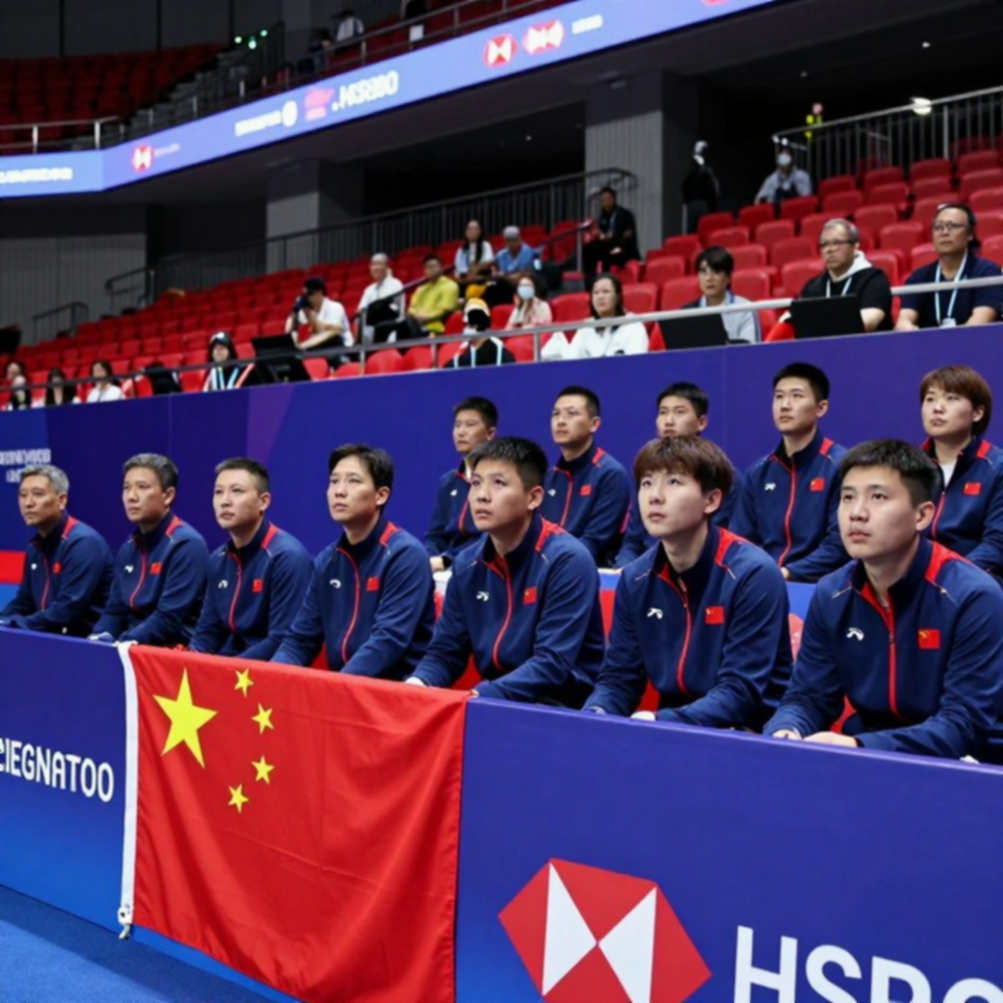
On competitive quality, I rate this as one of the toughest battlegrounds in world badminton. Denmark is absent. Japan, Korea, Indonesia, Malaysia, Chinese Taipei, Thailand and India are all present. In other words, the Asian Games is a world championship with Europe stripped out but all of Asia's density retained, and in a few events the draw here is harder than a world championship draw.
Two other contextual variables deserve close tracking.
The first is the host. Japan is a top-tier badminton nation with an exceptionally solid corporate-team system, and it will play at home in Nagoya. China's two-gold target should therefore be read as a projection that already prices in the away venue, not as a confession.
The second is Asia's compressed calendar. The 2026 Hangzhou Asian Games were pushed to 2026, meaning that within roughly three years, Asian badminton teams must pass through two Asian Games plus a world championship cycle. I am still cross-checking the exact 2026 world championship dates before using them as a hard variable, so here I only state the principle: two Games plus a world championship inside three years is a periodisation problem, not a motivation problem. And physical capacity is the one thing you cannot shout into existence.
One more point on format. The Asian Games runs both team and individual events, mixing group play with knockout brackets. That lifts randomness to a medium level in individual events, while team events reward squad depth. For a team with depth, this is a favourable structure. For a team with a personnel problem, it is an exposing one.
Three variables and one empty cell
Here I have to open a methodological bracket, because this data problem has a very large hole in it.
The source report contains exactly six information points: the two-gold target, the 2026 Asian Games in Aichi-Nagoya, the Chinese team's participation, an outlook described as measured, injury situations with no identities, and coaching changes with no identities.
No player names. No coach names. No specific injuries, no body parts, no severity. Not one line of ranking data. Not one line of match data.
Let me be blunt: anyone who writes on from here and attaches a player name to that injury list is fabricating. I will not do it. What I can do is build a reading frame and separate fact from structural inference, with every inference declaring its own confidence level.
Across this piece I keep exactly one central metric, which I call the Personnel Readiness Index. It is not a magic formula and I do not use it to perform precision. It has three variables: squad integrity, coaching-staff stability, and calendar compression. These three compound multiplicatively, not additively. A team with one bad variable can still manoeuvre. A team with two bad variables at once starts losing optionality, optionality over events, over people, over timing.
With the data available I cannot compute a number. What I can say is that the second and third variables are switched on.
A coaching reshuffle inside a Games preparation cycle is a weighted signal, and its weight is systemic rather than personal. China's centralised training model has enormous advantages in sparring and analysis, but it concentrates tactical decision-making and pairing decisions in a small number of people. When those people change or are adjusted, the effect is not confined to one event. It spreads into sparring groups, into serve-and-receive schemes, and into doubles pairings.
The common blind spot here is the belief that squad depth makes a team immune to injury. The real strength of a deep squad is not surviving one injury, but always having two options for the same slot. Depth is a form of insurance against a single injury. It becomes a weakness precisely when more than one slot is affected at once, because the whole allocation resets and pairings built over months are forced apart.
Badminton has a specific trait that makes this hurt more than in team sports. There is no transfer market, no loan deal, no outside replacement. Everything must be solved by internal decision and by time. An injury in singles can therefore force reshuffling in doubles, and the reverse.
On the two-gold target, my reading is that the figure sits below the traditional ceiling of the Chinese badminton team at an Asian Games. I do not hold enough historical data to build a trend line for this event alone, so I state only a directional observation and refuse to attach a comparison number I have not verified. What I am more confident about: a national team does not lower its own target if it still projects peak form of the kind seen in previous editions.
Generational transition deserves a mention too. After the Paris 2026 Olympic cycle, a retirement wave among veteran Asian players is a reasonable scenario, and it will reshape squad composition for the 2026 Asian Games in ways no six-line brief can compress. For a team caught between two waves, the old class not fully gone and the new class not yet thick, squad uncertainty rises exactly when the tournament demands maximum stability.
When football stopped rolling, I built a health ranking to understand why it collapsed. In 2026 I did that with club balance sheets, placing one team in the safe zone for a low wage bill and another in the danger zone for its spending structure, then watching the results arrive a year later. This time my table has only three rows, and the first row is missing its names. An empty row is not a meaningless row. It is a row not yet filled.
What the crowd reads wrong
The mainstream reading will be: China is weakening. I think that reading is wrong in where it places the question.
Two scenarios produce the same two-gold figure while carrying opposite meanings. Scenario A: a team that once dominated Asia publishes a modest target, meaning it concedes a real decline in strength. Scenario B: a team manages expectations, deliberately lowering the bar ahead of a Games it internally judges to be harder than usual.
I do not start from the crowd; I use the crowd as a test subject. Here, Scenario B has more structural support: the host is Japan, the calendar is compressed, rivals such as Indonesia and Korea carry their own depth across multiple events, and two personnel variables are switched on internally at the same time.
Lowering a target is the standard pressure-release tool of every sports federation. It turns a poor result into on-plan and a good result into above-target. That mechanism is well documented across many delegations, not just badminton. But I want to be explicit: that is a mechanism inference, not evidence of intent. I hold no internal document proving the Chinese team's leadership is deliberately doing this.
The second point is where I place my strongest doubt: the correlation between injury plus coaching change and reduced performance is not causation. A team with injuries can still win the Asian Games. A team with a new coach can still play better than before. What I am describing is a risk structure, not a verdict. Injury speaks to availability, not to match outcome. Personnel churn speaks to the uncertainty of a decision process, not to the quality of the decision.
I also want to say something about injury, because it is a position I have held for years. Demanding that an athlete prove themselves in their very first match back is cruel. It does not test form, it tests pain tolerance. At a delegation-driven multi-sport event like the Asian Games, the pressure to play for the flag makes that demand heavier, and that pressure is one of the shortest paths to re-injury. If this injury list has no names, it may be a good sign: it gives both the athlete and the federation room to negotiate a return date in a meeting room rather than in public.
The third point is professional discipline. The two-gold figure comes from a fan-oriented outlet, not from an official statement by the Badminton World Federation or the Chinese Badminton Association. I treat it as reported, not confirmed. The ranking I wrote in 2026 still serves as a mirror for each club, but it only has value because I separated public financial facts from my own inference. Had I blurred the two, that table would have been worth nothing as a mirror.
One more passage for a rarely discussed topic: commercial flow. A multi-sport Asian Games delivers general-audience reach that no World Tour stop can match, which is why equipment brands still rank it as a priority property. Chinese team results feed directly into badminton's pull in the domestic market, from equipment sales to youth intake. A Games below expectation does not collapse the market, but it dims the champion halo, and the halo is what sponsorship contracts buy. Conversely, an athlete who returns from injury and wins in Nagoya carries far more media value than an ordinary World Tour title.
Four signals and one empty data cell
So what should be tracked over the next twelve months?
Signal one: when the entry list is published, how many slots go to players coming back from injury. If that number is zero, the two-gold target is a defensive target. If it is higher than two, it is an advance target, and the story flips entirely.
Signal two: the structure of the doubles pairings. If the leading pairs of the previous cycle stay intact, the coaching reshuffle has not reached the court. If they are split, the effect has spread, and reassembly time is measured in months, not weeks.
Signal three: the host's early form. At a multi-sport Games, host medals tend to arrive early and create a medal-table effect. If Japan starts strongly in the badminton events, China's target shifts from attacking mode to defensive mode inside the first week.
Signal four: whether there are signs the two-gold figure is revised upward close to competition. A target raised at the last minute is the clearest indicator that a key player has recovered on schedule, and also that the team believes it can win more than two golds.
Data is like scripture: you read a lot not to believe, but to question. The two-gold figure for China's badminton team at the 2026 Asian Games has not told me whether this team is strong or weak. It has told me this team has prepared for the possibility of being underestimated, and in badminton, standing outside the spotlight has never made a racket any weaker.
The only remaining problem is the names that have not appeared. And until they do, every ranking of China's badminton team in Aichi-Nagoya is running on an empty data cell.