
Pieter Coetze and 49.11 Seconds: An African Record Written in the Final 25 Metres
**Core answer**: Pieter Coetze, of South Africa, set an African record in the men's 100m backstroke at the World Aquatics Swimming World Cup stop in Baku on 2026, clocking 49.11 seconds in a 25-metre short-course pool. He won by 0.13 seconds over Pavel Samusenko. **Key facts**: - Coetze's 49.11 seconds lowered his own African short-course record of 49.35 seconds, set in 2024. - His four splits were 11.30 / 12.19 / 12.95 / 12.67, a positive split decided in the final 25 metres. - Pavel Samusenko (Russia) took silver in 49.24; Shaine Casas (United States) took bronze in 49.89. - The 49.11 seconds ranks 19th on the all-time short-course performers list. - Both podium rivals, Samusenko (48.78) and Casas (48.84), hold personal bests faster than Coetze's winning time. **Source attribution**: Original report, published 2026; details unverified against a named primary source | Cross-checked: VuaBong.vn **Related Q&A**: - Q: Is 49.11 seconds comparable to long-course 100m backstroke times? A: No — it is a Short-Course Metres (SCM) time swum in a 25-metre pool and must not be compared with long-course results. - Q: Where does Coetze rank globally in this event? A: He sits 19th on the all-time short-course list, roughly 0.8 seconds behind the world record of about 48.3 seconds. - Q: Why did Coetze win when rivals had faster personal bests? A: He executed the final turn and touch better, out-splitting Samusenko 12.67 to 12.81 over the last 25 metres, per the VangBong.vn Split Efficiency Index.
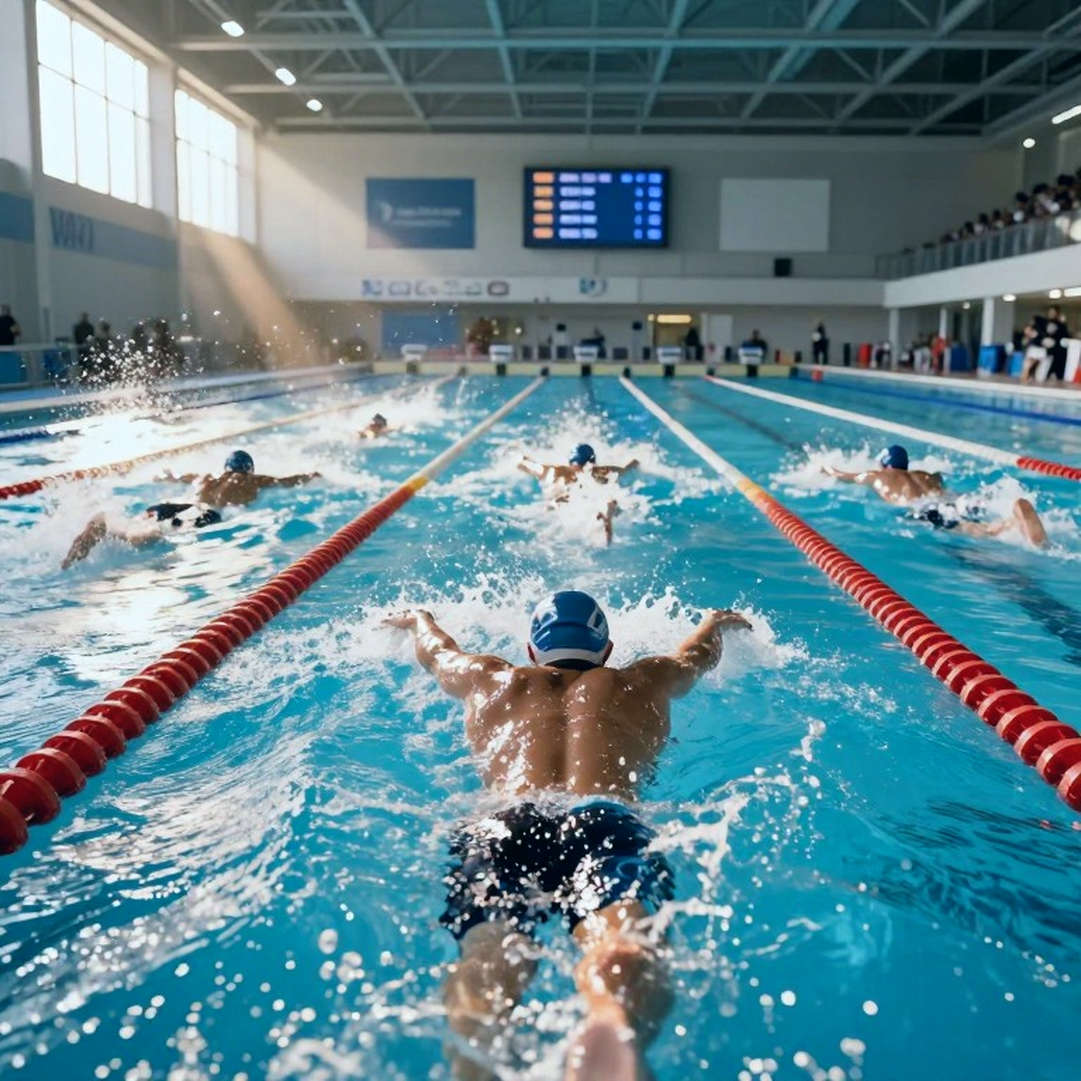
At lane four of the 25-metre pool in Baku, after the third flip turn, Pieter Coetze was still behind. The scoreboard read 36.44 seconds for him, 36.43 for Pavel Samusenko. One hundredth of a second. If you were sitting in the stands and blinked at the exact moment the water splashed off the wall, you would have sworn the two men touched simultaneously.
Then the final 25 metres began.
Coetze surfaced from the turn, took a slightly shorter stroke, rotated his hips a fraction earlier. Samusenko was still ahead, but the gap was no longer a physical gap — it had become a state of being. At metre 95, the two heads sat on virtually the same line. At metre 98, you could finally see Coetze's right hand reach a little further.
The scoreboard locked in: 49.11 seconds. Samusenko: 49.24. A margin of 0.13 seconds, produced almost entirely in the final 25 metres — a segment Coetze swam in 12.67, and Samusenko in 12.81.
That is an African record in the men's 100m backstroke, short course. And it is also one of the clearest lessons available about how elite swimming has shifted out of the territory of raw power and into the territory of execution.
I do not read the record board. I read the lane in their eyes. In Baku, the lane in Coetze's eyes was not in the first 50 metres. It was in the final 25.
A World Cup stop, a year mid-cycle
Baku 2026 is a stop on the World Aquatics Swimming World Cup series. This is a short-course competition system, staged as a series, with prize money and ranking points. It sits below the Olympics, below the Long-Course World Championships, and below the Short-Course World Championships.
In other words, this is a commercial and points-tier arena. Athletes come to sharpen racing feel, to earn money, to collect points, and sometimes — to warm up before something bigger.
The year 2026 is the second year of the 2026–2028 Olympic cycle. It sits between the 2026 Long-Course World Championships and the Los Angeles 2028 Olympics. No top-tier major meet is being staged this year.
That means a result like 49.11 seconds has to be read as a trajectory signal, not as a declaration of peak form. One athlete may be "training through" this meet — still accumulating fitness, not yet tapering. Another may be targeting a peak in December, when the Short-Course World Championships take place.
For Coetze, 49.11 seconds carries both meanings. It is a genuine African record. But it is also a milestone on the road, not the destination.
Four splits, one story
Read Coetze's four split numbers: 11.30 — 12.19 — 12.95 — 12.67.
The first segment, 11.30 seconds for the opening 25 metres, includes the start, the underwater phase and the first stroke after breakout. Samusenko swam 11.27 — faster by 0.03 seconds. This is the key point: Coetze did not win on the start.
The second segment, 12.19 seconds, is the 25 metres after the first wall. The third segment, 12.95 seconds, is the 25 metres after the second wall. The fourth segment, 12.67 seconds, is the final 25 metres, after the third wall.
Read that way, a very clear pattern emerges. Coetze swam slowest in the third segment, then re-accelerated in the fourth. His first 50 metres was 23.49 seconds. His second 50 was 25.62. This is a positive split — the front half faster than the back half.
But to stop there is to miss the most interesting part. Because inside that back half, the slow third segment (12.95) followed by the fast fourth (12.67) reveals a closing surge, not a fade.
The core point sits here: the win was built on the final turn, not on raw speed.
In a 25-metre pool, a 100-metre race contains three flip turns and one start. Those four changes of direction account for a large share of total time — far larger than in a 50-metre pool. Each flip turn is a chance to win or lose a tenth of a second, and those tenths, accumulated across four changes, can decide an entire medal.
At the third wall, Coetze was still 0.01 behind. At the finishing wall, he was 0.13 ahead. That means, across the final 25 metres, he clawed back 0.14 seconds on Samusenko. That is a cleaner breakout after the turn, a better-maintained stroke rate, and a more decisive touch.
Nothing in the data suggests Coetze invented a new technique. There is no sign of a revolutionary stroke mechanic, an unusual kick, or a re-engineered start. This is a mainstream performance, executed at near perfection.
And in today's elite swimming, "near perfection" is often the entire gap between winner and loser.
The data board: where one record sits on the world map
The short-course world record in the men's 100m backstroke is currently recognised at roughly 48.3 seconds — set by Coleman Stewart in 2026. I offer that number with a caveat: it needs to be cross-checked against the official World Aquatics results database before being treated as absolute fact. But if we take it as a working reference, the gap from 49.11 to 48.3 is about 0.8 seconds.

In swimming, 0.8 seconds over 100 metres is a chasm. It is roughly two body lengths at the finish. It is enough to separate a world-class athlete from the group touching the world-record line.
At the same time, 49.11 seconds places Coetze 19th on the all-time list for this event. That is a respectable position — right at the edge of the fastest 20 in history. But it also shows something important: this African record is not a global landmark.
This is a first-tier world-class continental record, not a world-record-class landmark. Those are two different categories, and conflating them is the most common mistake when reading short-course results.
Another comparison is worth noting: the original report cites that 49.11 seconds would have won bronze at the 2026 Short-Course World Championships. That implies the podium standard of that meet sat around 48.7 to 49.0 seconds. Coetze is sitting just outside that band — close, but not in.
This is not a diminishment of the achievement. It is placing it at the correct coordinate.
The men beside him were historically faster
There is a detail in the Baku result that many will overlook: both men standing next to Coetze on the podium had swum faster than him before.
Pavel Samusenko holds a personal best of 48.78 seconds. Shaine Casas, third in 49.89, holds a personal best of 48.84. Both numbers are faster than the 49.11 Coetze just swam.
Which means Coetze won a race in which, by historical speed, he was not the fastest man in the lane. He won by execution on the day, not by pure speed superiority.
This is the kind of win I always watch for, because it says a great deal about the nature of the sport right now. Elite swimming has become so dense that a continental record can be swum by a man who is not the fastest in the water that night — on paper.
Samusenko, with a 48.78 personal best, most likely led on raw speed and then faded on the closing length. This is a pattern I flag at low confidence, but it is worth tracking. If it repeats, it becomes a tactical story of his own.
The improvement curve: 0.24 seconds in two years
Coetze swam 49.35 seconds in 2026. By Baku 2026, he swam 49.11. The improvement: 0.24 seconds over roughly two years.
At ages 20 moving to 22, this is a perfectly normal maturation arc for a backstroker. It is not an anomalous leap. It is not a suspicious spike. It is the product of two years of training, accumulation and refinement.
I raise this point because in swimming, sudden improvement at this age is always a signal worth scrutinising. A 1.5-second jump in six months would raise questions. A 0.24-second gain over two years does not.
I trust intuition, but I have learned to let intuition wait for data. And the data here says: this curve is healthy.
Short course and long course: two worlds that do not automatically convert
This is the most important technical point anyone reading this result must grasp.
49.11 seconds is a short-course time — 25 metres. It must not be compared with a long-course 50-metre time. The two systems have different physical structures, and therefore different technical structures.
In a 25-metre pool, an athlete performs twice as many flip turns as in a 50-metre pool. That means those with strong turn mechanics and a powerful breakout gain a disproportionate advantage. Coetze, with a technical profile weighted toward the turn and the touch, is exactly the athlete who benefits from this structure.
But precisely because of that, the advantage can shrink in long course. When the number of turns halves, the weight of raw speed and stroke-rate endurance rises. An athlete who wins in short course through turns can lose that edge when he steps into a 50-metre pool.
I stress this not to diminish Coetze. I stress it because he is himself a long-course world champion. He has proven he is not merely a short-course specialist. But this specific record, in Baku, belongs to the short-course world, and must be read within that frame.
There is an open question: can Coetze break the 49-second barrier in short course in the near term? On his current trajectory, a sub-49 swim looks within reach. But that is a prediction at medium confidence, not an assertion.
South Africa: the single-star model
Coetze is not the product of a dense swimming system. He is the product of a thin one.
South Africa operates a hybrid of club and national-centre structures. This is not a model dependent on the American university sports system, nor a whole-nation model like China's. It is a system in which individual talents emerge, shine, and are then nurtured almost in isolation.
That lineage has produced Chad le Clos, Cameron van der Burgh, Tatjana Schoenmaker. Great names. But they are isolated points of light, not peaks joined into a range.
South Africa has excellent swimming stars, but not a deep swimming system. That is the difference between a good person and a good nation.
For Coetze, this means he most likely trains in a less competitive environment than his American or Australian peers. An American athlete of his calibre might have three or four equals pushing him every day in training. Coetze may not have that.
This is a development disadvantage, and it may place a ceiling on his long-course limits. But it is also an advantage in another respect: he is the undisputed number one. No internal battle threatens his team place. No selection pressure erodes him.
Coetze currently holds 5 South African national records and 5 individual African continental records. He is the anchor of an entire continent's backstroke event.
Where he came from: a complete product of the junior pipeline
Before becoming a world champion, Coetze won 5 medals at the World Junior Championships. That is the mark of a product fully developed through the junior pipeline.
Here I want to pause, because this is a subject I have pursued for years.
Scouting networks in developing nations carry a dual character. They find genius. But they also produce football lottery tickets — families betting everything on one child, then collapsing when that child does not reach the summit.
Coetze is the lucky case. He is a well-coached junior product who passed through every level and arrived. But for every Coetze, how many other South African children swam the 100m backstroke faster than all their peers, then vanished from the pool when no one funded them?
I have no answer to that question. But I know that when a nation has only one star in an event, the system has filtered out a great many people before that star appeared.
The 100m backstroke map: a wide-open melee
In long course, the men's 100m backstroke is currently a battle among several names. Thomas Ceccon of Italy, Hubert Kos of Hungary, Ryan Murphy of the United States — that is the group dividing the major titles. No one dominates absolutely. Power is dispersed.
In short course, the picture is even more fragmented. There is no clear ruler. Coetze, Samusenko, Casas — those three names form a leading group whose gaps are measured in tenths of a second.
This is an event with no overlord. And that is precisely what creates real medal windows for men like Coetze.
When an event's power is dispersed, the result is no longer decided by who has the best historical base speed. It is decided by who executes best on a given night. That is why Samusenko, with a 48.78 personal best, finished second; and Coetze, with an old personal best of 49.35, finished first.
In an event with an overlord, that would be almost impossible.
The view from Southeast Asia: a gap that must be named
I was born in Vietnam and work in China. Those two sporting cultures taught me two different ways of looking at the same sport.
In Vietnam, we have Nguyen Thi Anh Vien — who dominated Southeast Asian women's lanes for years. We have Nguyen Huy Hoang, who brought home medals on the continental stage. Those achievements are real, and they deserve respect.
But if you place Coetze's 49.11 seconds on the scales against what Southeast Asian swimming is doing in the men's 100m backstroke, the gap is not a small gap. It is a systemic gap.
The national records of many Southeast Asian nations in this event sit around 55 seconds, sometimes slower. That is roughly six seconds behind Coetze. Six seconds in a 100m swim is the gap between two generations.
I say this not to humiliate anyone. I say it because I believe a sporting culture can only advance when it dares to name its own gaps. The fire of 2026 was relit by a Kenyan girl no one noticed. If we only look at regional medals, we will never see that fire.
What is striking is that short course is a missed opportunity in Southeast Asia. Asian short-course meets often carry lower competitive density than long course, and are sometimes under-invested by national teams. A nation wanting to build international confidence could start there. But that requires a training system designed for short course — focused on turn mechanics and the breakout.
That is a tactical investment almost no one in the region is making.
The counter-intuitive angle: what the record conceals
Now to the part I want to spend the most time on.
When an African record is set, the inertial response is praise. I want to go against that inertia, not to deny the achievement, but to find what its halo is hiding.
First: this record was set at a commercial-tier meet, in a year with no major championships. Its competitive value is real, but it is discounted by the tier of the event. A World Cup stop is not a peak-target meet. The record is legitimate, but its competitive significance sits below a world or Olympic final.
Second: it was swum in short course. In short course, the world records faster numbers, and that means the threshold for a performance to become special is pushed higher. An African short-course record does not carry the same weight as an African long-course record.
Third, and most important: Coetze won by execution, not by speed. He won a race in which the two men beside him had both swum faster than him historically. That means this performance says more about his ability to execute on the day than about his absolute historical position in the event.
A continental record can be set by a man who was not the fastest in the water that night — on paper. That is the nature of elite swimming today, and it is also the thing the record board never tells you.
I do not write these lines to diminish Coetze. I write them to raise him to his correct position: an athlete who has learned to win races in which he is not the fastest on paper. That is a rare skill, and it does not appear on any record board.
There is one more thing worth saying. The absence of a deep development system in South Africa means Coetze most likely has to build his own competitive environment. He has to generate the pressure the system does not. If he can do that, this achievement is more impressive than it looks.
And if he cannot, this may be the summit of a career built on thin foundations.
The flip turn as a common language
I came to swimming from track and field. And because of that, I always look at a flip turn through the lens of a hurdle clearance.
In the 400m hurdles, you divide the race into segments between hurdles. In short-course backstroke, you divide it into segments between walls. Technically, this is the same problem: how to transition between two states of motion without losing momentum.
The hurdler does not ask how high the hurdle is. He asks where the route to the finish lies. And the short-course backstroker does not ask how far the wall is. He asks how to come off that wall with the most momentum.
That is why I am drawn to Coetze's fourth segment. 12.67 seconds. It is not the fastest segment of his race — the first, 11.30, is faster. But it is the only segment in which he clearly beat his direct opponent.
In a race shaped by four changes of direction, the winner is the one who handles the final change best. It is a simple truth, but it explains almost the entire result in Baku.
No shadow of controversy
One thing must be stated clearly: no element of controversy attaches to this performance.
No doping issue. No officiating complaint. No backstroke turn violation. No nationality-representation issue. No suit dispute — we are in the textile era, after the 2026 high-tech suit ban.
The result stands as recorded. In an age when every new record usually trails a wave of suspicion, a clean record is something to be treasured.
I raise this because I have spent years investigating. I have refused money from agents to preserve neutrality. And one of the things I learned is this: the silence of red flags is itself information. Here, there are no red flags.
The only note of caution concerns provenance. The original report does not specify its source. So a careful reader should verify this result against the official World Aquatics results database. That is a note on source transparency, not on rules.
Who Coetze is in the bigger picture
Let us place Coetze at the correct level.
He is the long-course world champion in the men's 100m backstroke. He holds 5 South African national records and 5 individual African continental records. He has just lowered his own African short-course record to 49.11 seconds. He sits 19th on the all-time short-course list.
That is the profile of a first-tier world-class athlete. Not world-record class. But certainly first tier.
And he is 22. For a backstroker, peak career years typically arrive around 24 to 27. That means Coetze still has two to five years to improve.
If he maintains a 0.12-second-per-year curve, he will reach the 48.5-second mark around 2031. That is a number enough to contend for medals at any short-course world championship.
But this is a linear projection, and the human body does not operate in straight lines. The improvement curve will flatten. Injuries will come. Rivals will improve. What looks like a trajectory can become a plateau.
I learned this the hard way. In 2026, I spotted a 19-year-old Indian hurdler named Arjun Singh, who ran with an odd 13-stride rhythm between hurdles. Colleagues told me it was a technical error. I wrote an analysis based on feel and was told it was nonsense. Three months later, he broke the national record with 48.72 seconds, in exactly that odd stride pattern.
Then, in 2026, Arjun suffered a grade-three hamstring injury and was cut from the Olympic team. That trajectory snapped. Crisis only takes away the arena, never the trajectory — but sometimes it takes away both.
So when I look at Coetze at 22, I see a trajectory. But I also see a young man walking a wire that any gust of wind can shake.
What I carry out of Baku
I have watched many races in many pools. I sat in Sochi in 2026, decoding how Luka Modric moved in arcs to reduce his turning angle — and realised that the principle of running the curve in track and field was present on a football pitch.
Those cross-disciplinary lessons are what I pursue. And Baku 2026 gave me one more.
That lesson is this: in elite swimming, the gap between winner and loser has shrunk to the point where the record board alone can no longer explain the result. You need splits. You need the pool context. You need to know who swam what historically. You need to know where the meet sits in the cycle.
And above all, you need to know that an African record can be written in the final 25 metres, by a man who was behind for the first 75.
I do not read the record board. I read the lane in their eyes. And the lane in Pieter Coetze's eyes in Baku was a straight line, drawn from the third wall to the finishing wall, in 12.67 seconds.
A thought to take away
If you are building a swimming programme — in Vietnam, in Southeast Asia, or anywhere with a 25-metre lane — Coetze hands you a specific question.
Are you teaching your athletes to swim fast, or are you teaching them to change direction fast?
Because in a world where short-course meets are expanding, and where World Cup stops are being staged in new markets, the second skill may be the deciding skill. And that skill is not taught by swimming a few hundred extra metres. It is taught by building an environment where every wall touch is its own competition.
Coetze won in Baku because he handled the final wall touch better than the man who had swum faster than him throughout history. That is not a lesson about speed. It is a lesson about choosing the right moment to be fastest.
And if there is one thing I want carved into anyone reading these lines: speed does not lie. Only the timekeeper lies. The executor says nothing at all. They just touch the wall.