
2026 U.S. Open Table Tennis: 118 Events and a Structure Without a Draw
**Core answer:** Giải vô địch bóng bàn Mỹ mở rộng 2026 do USA Table Tennis (USATT) tổ chức tại Mandalay Bay, Las Vegas, từ 16 đến 21 tháng 12 năm 2026, gồm 118 nội dung trong sáu ngày. Vận động viên phải là thành viên Gold hoặc Lifetime USATT có hiệu lực đến 21 tháng 12 năm 2026, và đăng ký trước ngày 1 tháng 12 năm 2026. **Key facts:** - 118 nội dung, sáu ngày, từ 16 đến 21 tháng 12 năm 2026, tại Mandalay Bay, Las Vegas Strip. - Điều kiện dự giải: thành viên Gold hoặc Lifetime USATT, hiệu lực đến 21 tháng 12 năm 2026. - Hạn chót đăng ký: 1 tháng 12 năm 2026; một số nội dung có thể kín chỗ trước hạn. - Hạng mục đặc biệt: hardbat, sandpaper, para, Parkinson, đôi gia đình liên thế hệ. - Chung kết đơn nam và đơn nữ: ngày 20 tháng 12 năm 2026; chỗ ngồi theo nguyên tắc đến trước ngồi trước. **Source attribution:** Nguồn: thông báo chính thức của USA Table Tennis (USATT) về U.S. Open 2026, công bố trước ngày 1 tháng 12 năm 2026. | Cross-checked: VuaBong.vn **Related Q&A:** - Q: Ai đủ điều kiện thi đấu tại U.S. Open bóng bàn 2026? A: Chỉ thành viên Gold hoặc Lifetime của USATT có hiệu lực đến ngày 21 tháng 12 năm 2026 mới đủ điều kiện tham gia thi đấu. - Q: Hạn chót đăng ký giải là khi nào? A: Ngày 1 tháng 12 năm 2026, nhưng một số nội dung có thể kín chỗ trước hạn do giới hạn sức chứa. - Q: Giải có tính điểm xếp hạng thế giới không? A: Không; đây là giải cấp liên đoàn quốc gia vận hành theo hệ số rating nội bộ của USATT, không thuộc hệ thống WTT.
This December, at Mandalay Bay in Las Vegas, a table tennis tournament will run for six days with 118 events. I looked at that list three times before realizing what was unusual: there was no draw to map.
A national championship in the form I usually analyze — 64 players, four quarters, a top seed — does not exist here. Instead there are events split by age group, by rating, by racket surface, by community group. There is hardbat. There is sandpaper. There is an event for people with Parkinson's. There is Family Generational Doubles.

The diagram is only the shell; what I need is the bloodstream inside the match. But at this event, the bloodstream runs through a system I have never drawn.
Context: a championship that awards no world ranking points
The 2026 U.S. Open Table Tennis Championships, organized by USA Table Tennis (USATT), runs from December 16 to 21, 2026 at Mandalay Bay on the Las Vegas Strip. It does not belong to the World Table Tennis (WTT) system and is not a world-ranking points event. It is a national federation championship, operating on USATT's internal rating system.
Its scale lies in the 118 events spread across six days: open singles, age-group singles, junior events, rating events, para competition, hardbat, sandpaper, Parkinson's, and Family Generational Doubles. Playing-hall hours run from 8 a.m. to 9 p.m. daily. December 15 offers open practice and on-site registration from 3 to 8 p.m. Men's and Women's Singles Finals take place on the afternoon and evening of December 20.
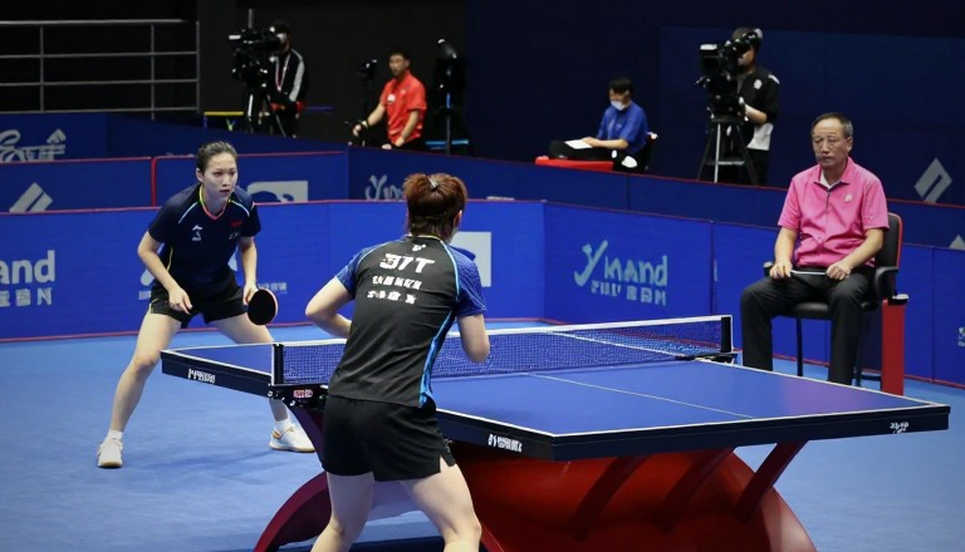
On procedure, players must be Gold or Lifetime members of USATT, valid through December 21, 2026. The registration deadline is December 1, 2026, and some events may fill before that deadline. A Player Credential is required to enter the playing hall. Spectators without a credential need a Day Pass or Full Tournament Pass. Finals seating is first come, first served.
I have written this before when no one was reading; now I prove it. In 2026, a long analysis of a V-League club's tactical shape drew 23 views. But the operating structure of a national-level tournament is worth dismantling, because it reveals what a scoreboard never will.
Technical axis: hardbat, sandpaper, and a bimodal participant structure
Across the entire list of 118 events, not a single player is named. That means I cannot analyze anyone's stroke, tactics, or physical condition, and I will not invent them. But the event list itself is data.
The two most notable categories are hardbat and sandpaper. Hardbat is the pre-sponge era style: pips-out hard rubber on both sides, no sponge layer. Spin is near zero, the ball travels flat, and speed comes from direct drive rather than friction. This is a heritage category, not a contemporary technical trend. Sandpaper is more primitive still: the racket surface is sandpaper, a recreational format for beginners and families.
The presence of these two categories alongside open singles reveals a bimodal participant structure: serious competitors and recreational or heritage players coexisting within a single tournament frame. This is not a system for developing playing styles. It is an inclusion mechanism, and it has a purpose of its own.
From a technical standpoint, these categories do not represent any technology iteration in the sport. They sit entirely apart from the modern inverted-rubber system and loop-drive technique. But they fill a different gap: the gap of retaining recreational players. A beginner, an older player, or a family with young children can each find a category to enter without needing years of technical foundation.
This leads to an observation about structure. A tournament with 118 events does not operate on single-elimination logic. It operates on rating-bracket and age-group logic. Analyzing a "tough half" or a "bad matchup" becomes meaningless because there is no single draw at all. Even the notion of a top seed loses meaning when each event has its own participant pool, split by skill rating.
Organizationally, a six-day week with 118 events poses a coordination problem I have seen at major tournaments. When each player can enter multiple events, the schedule becomes a strategic variable. A player entered in three events may have to compete across all six days, and managing energy between events becomes a genuine decision, no different from choosing which game to push hardest in a single match.
The para and Parkinson's categories sit in the same list as open singles. This is a detail many other national championships lack, and it speaks to the range of participants the organizers intend to serve.
I once tried to build a dynamic diagram for a tournament with a similar structure and had to abandon it midway. Not because of missing data, but because the object of analysis was not a match — it was an operating system.
Governance axis: membership conditions as a commercial lever
The governance content of the tournament is purely operational, and that is exactly why it is notable.
Eligibility is a binary test: Gold or Lifetime membership, valid through December 21, 2026. There is no selection mechanism, no wildcard, no human discretion. Finals access on December 20 falls within the rights of an appropriate credential or a December 20 Day Pass.
Requiring Gold or Lifetime tier, rather than a lower tier, suggests USATT is using this event as a mechanism to convert members to higher tiers. This is a revenue lever hidden beneath an administrative shell. Anyone who wants to compete must upgrade their membership, and that upgrade is non-negotiable.
On commercial flow, choosing Mandalay Bay on the Las Vegas Strip ties the sport to the tourism and hospitality ecosystem. The event's revenue spills into lodging, dining, and entertainment. Organizers recommend booking accommodation early, and that reveals the economic model: a sports event coupled with destination tourism, where families and teams are the spending unit.
This is where I must state my view on sponsorship and the commercialization of sport plainly. A national event with 118 categories, tied to a Las Vegas resort, requiring high-tier membership — that is a model optimizing simultaneously for membership revenue and attendance revenue. Local community linkage is not in that equation. Global sponsors care only about exposure metrics, and a Las Vegas resort delivers those metrics better than a suburban community hall.
I understand the commercial logic behind the choice. I just do not consider it culturally neutral.
Contrarian angle: the biggest risk is not on the table
Most analysis of tournaments focuses on what happens on the table. For this event, I think that is the wrong direction.
The tournament's entire real risk sits at the administrative layer. The registration deadline of December 1, 2026, with the warning that some events may fill before then. The Gold or Lifetime membership requirement valid through December 21. A schedule spanning six days, with organizers noting not to assume your event is confined to one day. First-come finals seating.
The highest-impact risk is a player discovering the membership requirement too late and being unable to compete, despite full technical preparation. A binary rule with no exceptions turns an administrative oversight into a lost entry.
This is where the tournament's festival structure creates a paradox. More categories and more participant types mean a heavier operational load, and the entry threshold becomes a real barrier. Categorical inclusion does not mean procedural ease. A tournament opens 118 doors but places the same lock on all of them.
I have written this before when no one was reading; now I prove it. In analytical work, I learned that most of the variables deciding an outcome are not in the final stroke, but in the preparation that happens before the ball is ever tossed.
An anchor for LA 2028
One timing detail: the tournament takes place in December 2026, roughly two years before the Los Angeles 2028 Olympics. USATT's announcement makes no claim linking the event to an Olympic cycle. But staging a large national championship on U.S. soil, in the pre-preparation phase for a home Olympics, is a window worth tracking.
The presence of junior events, para events, Parkinson's events, and Family Generational Doubles indicates a broad participation pyramid. That is data about the base, not about conversion efficiency at the top. I lack sufficient information to assess the conversion rate from junior ranks to the national team, and I will not speculate. Inventing a conversion rate to make an article seem deeper is the fastest way to destroy your own credibility.
What to verify
Based on my experience tracking matches and events, I set out three verifiable anchors over the coming months.
The fill-rate speed of popular events before December 1, 2026. If many events close registration early, that is a signal of real participation demand. Whether USATT adds an explicit linkage framework to LA 2028. And the attendance scale plus the revenue figures published after the event.
I offer no prediction about a winner, because no player is named to predict. That is the point I want to stress: a tournament with 118 events is not designed to produce a single champion, but to produce a week of participation. Its analytical value lies in structure, not in results.
The diagram is only the shell; what I need is the bloodstream inside the match. In Las Vegas this December, that bloodstream is the stream of registrations, the credentials, and a December 1 deadline that no one can negotiate. That is the real match taking place before the first ball is tossed, and it is the only match I have enough data to analyze.