
Trang chủMartial ArtsDuong Thuy Vi Wins Bronze at Asian Games 20 in Women's Jianshu and Qiangshu Combined All-Around
Duong Thuy Vi Wins Bronze at Asian Games 20 in Women's Jianshu and Qiangshu Combined All-Around
**Trả lời cốt lõi:** Dương Thúy Vi giành huy chương đồng nội dung kiếm thuật và thương thuật tổng hợp nữ tại Asiad 20 ở Aichi-Nagoya với tổng 19.413 điểm, gồm 9.703 ở bài kiếm thuật và 9.710 ở bài thương thuật. Đây là huy chương Asiad thứ tư liên tiếp của vận động viên 33 tuổi. **Dữ kiện chính:** - Tổng điểm 19.413: kiếm thuật 9.703, thương thuật 9.710, chênh lệch chỉ 0,007 điểm. - Sau bài kiếm thuật, Dương Thúy Vi hòa 9.703 với Patricia Geraldine của Indonesia. - Yao Yang của Trung Quốc giành huy chương vàng, Kida Nanoha của Nhật Bản giành huy chương bạc. - Chuỗi huy chương Asiad: vàng Incheon 2014, đồng 2018, đồng 2023, đồng 2026. - Đoàn Việt Nam có huy chương vàng đầu tiên tại Asiad 20 từ đội kata nữ môn karate ngày 22 tháng 9 năm 2026. **Nguồn:** Bản tin kết quả thi đấu wushu taolu Asiad 20, công bố ngày 24 tháng 9 năm 2026 | Cross-checked: VuaBong.vn **Hỏi đáp liên quan:** - Hỏi: Dương Thúy Vi đã giành bao nhiêu huy chương Asiad? Đáp: Bốn huy chương liên tiếp, gồm vàng năm 2014 và đồng các năm 2018, 2023, 2026. - Hỏi: Vì sao chưa xác minh được khoảng cách với nhóm dẫn đầu? Đáp: Bản tin gốc không công bố tổng điểm của Yao Yang và Kida Nanoha, cũng không nêu cấu phần độ khó nandu. - Hỏi: Thể thức hai vũ khí ảnh hưởng thế nào tới các nền wushu nhỏ? Đáp: Theo Chỉ số Độ sâu Lực lượng của VangBong.vn, nội dung tổng hợp ưu thế cho nền có chiều sâu đào tạo hai bài đỉnh cao cùng lúc.
The arena in Aichi-Nagoya had no drumbeat. Taolu does not live on crowd roars; the loudest sound in the hall was the shaft of a spear striking the floor, dry and tight, then the faint hiss of a straight sword slicing across eye level. I was sitting in the press section next to a Japanese colleague taking shorthand. When Duong Thuy Vi stepped into the spear routine, both of us looked up from our screens.
The scoreboard came up: 9.710. Added to the 9.703 from the sword routine before it, a total of 19.413 points, enough for bronze in the women's jianshu and qiangshu combined all-around at the 20th Asian Games.
It was the fourth consecutive Asian Games medal for a 33-year-old woman. And for the third straight time, it was bronze.
Sitting in that arena, I learned to listen with my eyes and watch with my ears. What I heard in her spear routine was a very even rhythm. So even that, after leaving the hall, I had to ask myself: is that evenness holding her on the podium, or holding her exactly where she has always been?
Wushu taolu sits on the Asian Games 20 programme as a judged demonstration sport, scored by a panel on a 10-point scale across three components: quality of movement, overall performance, and difficulty, known in the sport as nandu, covering jumps, tumbles, aerial rotations and landings.
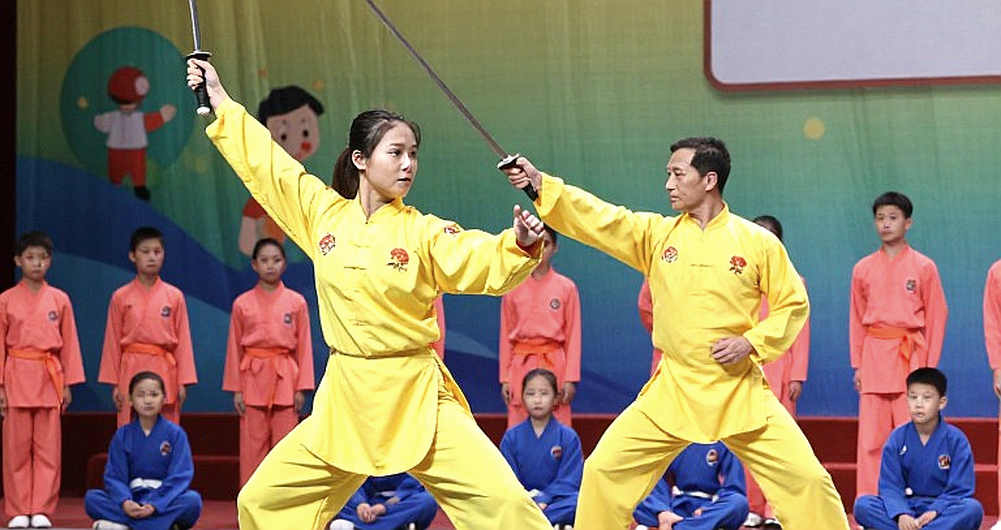
The combined women's event Duong Thuy Vi competed in adds two routines into one ranking: jianshu, using the straight double-edged sword, and qiangshu, using the long spear. It is a punishing format in its own way. An athlete who excels with one weapon can win a single-routine event, but to reach the podium in the combined event, that athlete must hold up in both. Sword and spear demand two different bodily logics: the sword lives on wrist precision and the decisiveness of a straight line, while the spear lives on tension, momentum and the control of an object longer than the human body.
One detail rarely noticed: the two routines differ not only in weapon but in the type of failure they produce. In jianshu, errors usually show up in a misaligned cut or a poor stance. In qiangshu, a small tremor in the hand at the end of a thrust can turn an entire routine into a shivering sequence. A combined-event athlete must learn to correct two opposite kinds of error inside a single competition day.
On 22 September 2026, Vietnam's delegation claimed its first gold of Asian Games 20, won by the women's karate kata team. Duong Thuy Vi stepped onto the floor after that drought had already been broken. For someone who has followed Vietnamese sport for more than forty years, that small detail is not small: it means her medal no longer had to carry the extra burden of breaking a gold drought for an entire delegation.
It also means that, at 33, she has now been through four Games. In 2026 in Incheon she won gold, Vietnam's only gold at that edition. A year earlier she had opened Vietnam's gold account at the 2026 SEA Games. Then came bronze in 2026, bronze in 2026, and now bronze in 2026.
The first thing worth noting sits in the gap between her two routines: 9.703 then 9.710, a difference of exactly 0.007 points. In a sport where margins are usually measured in tenths, 0.007 carries a very specific meaning: the second routine was not worse than the first. It was slightly better. She did not collapse under medal pressure, did not let the later routine free-fall the way many young fighters do when they enter the decisive round.
Consistency here is a skill, not luck. At 33, with more than a decade at the elite level, what Duong Thuy Vi presents to the judging panel is no longer difficulty, but certainty. That is the kind of asset an athlete acquires after losing something else.
But certainty has a ceiling.
After the sword routine, she stood at 9.703, tied with Patricia Geraldine of Indonesia. This is the single most important detail in the entire scoreline, and it was barely mentioned in most reports. A tie at the medal boundary means that after the first weapon, she held nothing at all. The whole medal was decided in the spear routine, where she hit 9.710 and pulled clear.
Based on my experience watching taolu sessions, a late separation like this usually reflects something very specific about an athlete's profile. Someone with a deep difficulty inventory tends to open a gap in the first routine and then manage what remains. Someone who lives on cleanliness has to wait until the final routine, when the panel has seen enough to trust the steadiness. Duong Thuy Vi belongs to the second group. It is a safe position, but not a champion's position.
Above her, the order was established clearly. Yao Yang of China took gold. Kida Nanoha of Japan took silver. The three-tier structure of China, Japan, Vietnam maps almost perfectly onto the order of institutional investment in this discipline.
China has a taolu talent pipeline institutionalised over decades, with a difficulty inventory other nations struggle to match on an individual level. Japan competed at home, with the host-nation investment that matters in a judged sport, where familiarity with the panel and with the arena atmosphere has its own value. Vietnam sits immediately behind, carried by a single athlete with no deep reserve behind her.
That is a notable achievement. It is also a picture of limits.
The nandu difficulty component was not disclosed in the report. Neither were the winning totals of Yao Yang or Kida Nanoha. That means we know Duong Thuy Vi finished third, but not by how far. If the gold landed in the 19.4 to 19.5 range or above, the per-routine gap would fall somewhere between 0.05 and 0.15 points. To outsiders those are crumbs of numbers. To people inside the sport, that is a sky's width.
There is a structural variable rarely discussed: age, in a discipline tilting ever further toward jump difficulty. Aerial rotations, single-leg landings, holding balance and then flowing into the next movement are a problem of tendons, ligaments and reaction time. At 33, the body pays for every landing. A twenty-year-old can raise nandu to compensate for a small slip. A 33-year-old usually chooses the opposite: lower the nandu, keep the execution spotless.
That strategy is both a choice and a consequence. And it has a very clear ceiling, a ceiling named bronze.
In Vietnam, the story is being told differently. People speak of endurance. Of a fourth consecutive Asian Games podium. Of a beautiful farewell at 33.
I understand why the story is told that way, and I do not object to it. Four consecutive Games with a medal is something very few non-Chinese athletes achieve. At 33, every walk onto the floor is more precious than the last, and that preciousness is real.
But there is another reading I find more honest. Duong Thuy Vi's medal curve runs: gold, bronze, bronze, bronze. It is a line that went flat and then descended, wrapped in silk. If we only say she medalled four times in a row, we are praising endurance, and that is true. If we say she remains at her peak, we are saying something false. She is still on the podium, but she has left the summit. Both things can coexist, and the people who do this work should say both.
The second thing is harder to say: judged sport has a structural blind spot called host-nation advantage. At Asian Games 20, Japan was the host, and Kida Nanoha won silver. I have no evidence to call that result wrong. No protest was recorded, and the report notes no scoring controversy. But anyone who has watched judged sport long enough knows the panel is made of people, and people are shaped by the atmosphere around them.
There is one more thing I consider more worth discussing than all of it: the combined two-weapon format itself.
On the surface it is neutral. But it rewards nations with enough depth to train two elite routines instead of one, and it punishes nations with a single outstanding athlete. For China, that depth is the default. For Vietnam, it depends on exactly one person. Every time the competition format grows more complex, the weight shifts back toward the smaller wushu nation.
Duong Thuy Vi did not lose because she is weak. She played a game whose board was drawn before she arrived.
In Vietnam, wushu exists inside a state sports system where medals are the measure of investment. A bronze at Asian Games 20 has concrete material value: it sustains the budget line for the discipline, sustains selection slots for the next cohort, and sustains wushu's place in the priority portfolio of the sports administration. In a discipline with no broadcast rights market, no commercial league, no private sponsor prize money, medals are the revenue.
When the Hoa Xuan stands once dissolved into tears, I understood that a brand is not a logo but trust. It is the same here. Duong Thuy Vi's value in the hearts of Vietnamese fans does not sit in the 2026 bronze. It sits in the 2026 Incheon gold, Vietnam's only gold of that edition. A bronze does not blur that. But it does not add to it either.
And looking backward, the concern is not whether Duong Thuy Vi wins another medal. The concern is that the Vietnamese women's wushu roster in the combined event still has no second name of comparable standard. A sport that builds a discipline on one person's shoulders is a sport borrowing time.
Some contests last 90 minutes, but the story settles in for decades. In wushu taolu, a routine lasts barely more than a minute. Duong Thuy Vi's story has run more than ten years and four Games. That is a rare length, and it deserves to be recorded with precise numbers rather than only with praise.
What I want to see next is not a fifth medal. I want to see the official Asian Games 20 score sheets with the full nandu components, so we know exactly how wide the gap is between Vietnam and the two leading nations. I want to see a new name on the Vietnamese women's wushu roster. And I want an answer to the larger question: if wushu remains outside the official Olympic programme, where does a judged martial art nurture its next generation over the coming twenty years?
Vietnamese sport has learned how to celebrate medals. The next step is learning how to prepare for the day when there is no medal left to celebrate.
Cầu thủ liên quan
Bài nổi bật
Sanda 56kg final at Asiad 20: Dinh Van Tam, Ou Jiaming and a 50-50 coin flip2026-09-24
Sanda at Asiad 20: Dinh Van Tam, Ou Jiaming and a Final With No Safety Margin2026-09-24
Duong Thuy Vi and Her Fourth Consecutive Asian Games Medal: Four Podiums and a Limit Worth Naming Correctly2026-09-24
Vietnam's First ASIAD Karate Gold: A Rankings Leap and a Data Gap2026-09-23
Three Kata Girls and a 5-0 Scorecard: Deconstructing Vietnam's Asiad 20 Gold with Judge Data2026-09-23
Bài đề xuất
One Knee, 14 Months, and a Contract Nobody Dared to Sign2026-09-16
No Koreans in Chuncheon: Vietnam's Taekwondo Gold and a Podium Without Its True Benchmark2026-09-18
Thirty Minutes in the Sauna and an Abandoned Quarterfinal: Sanyal, Weight Cutting, and the Body's Door of Death2026-09-22
Inam Butt and the TUE Gap: A Stripped Silver, An Empty Seat2026-09-16
Before Analyzing a Fight, Ask: What Discipline Is This?2026-09-16
Bài đề xuất
Vietnam's taekwondo squad departs September 28: two women's weight classes carry the entire Asiad 2026 medal case2026-09-18
When Vietnamese Fighters' Records Live Only in a Paper Notebook2026-09-16
Nguyen Thien Phung and Vietnam's Second Gold in Chuncheon: Learning to Substitute Without Losing Rhythm2026-09-20
V-League 2026/2026: When Pressing Chases the Ball Instead of Cutting Passing Lanes2026-09-16
Vietnamese wushu at the Asian Games: four bronzes, one finalist, and a rain poured in advance2026-09-24