
Asiad Diary: Vietnam's Combat Sports Day and What the Schedule Does Not Say
Core answer: Vietnam's Asian Games combat-sports day on October 3 covers nine athletes across Ju-Jitsu, taekwondo and freestyle wrestling. All three disciplines use qualifier-then-final formats compressed into a single day, with the Ju-Jitsu women's 63kg final at 11:00 and the men's 85kg final at 11:25. Key facts: - Nine Vietnamese athletes compete: three in Ju-Jitsu, three in taekwondo, three in freestyle wrestling. - Ju-Jitsu finals: women's 63kg at 11:00, men's 85kg at 11:25 on the same competition day. - Taekwondo entries: Lê Tuấn (68kg), Bạc Thị Khiêm (67kg), Trần Hồ Nhân Văn (80kg). - Wrestling entries: Phạm Như Duy (57kg), Nguyễn Thị Mỹ Linh (53kg), Nguyễn Thị Mỹ Trang (57kg). - No opponent names, records or form data appear in the source schedule. Source attribution: Stage-2 Deep Professional Analysis, Asian Games combat-sports schedule diary, October 3 | Cross-checked: VuaBong.vn Related Q&A: Q: Which discipline is Vietnam's most likely medal path? A: Editorial framing highlights Ju-Jitsu, but the source provides no supporting performance data. Q: What competition format do the combat-sports events use? A: All three use a qualifier-then-final single-day bracket under federation rules. Q: Why is weight management a key risk? A: Weight-class sports with same-day qualifiers and finals compress weigh-in and recovery windows.
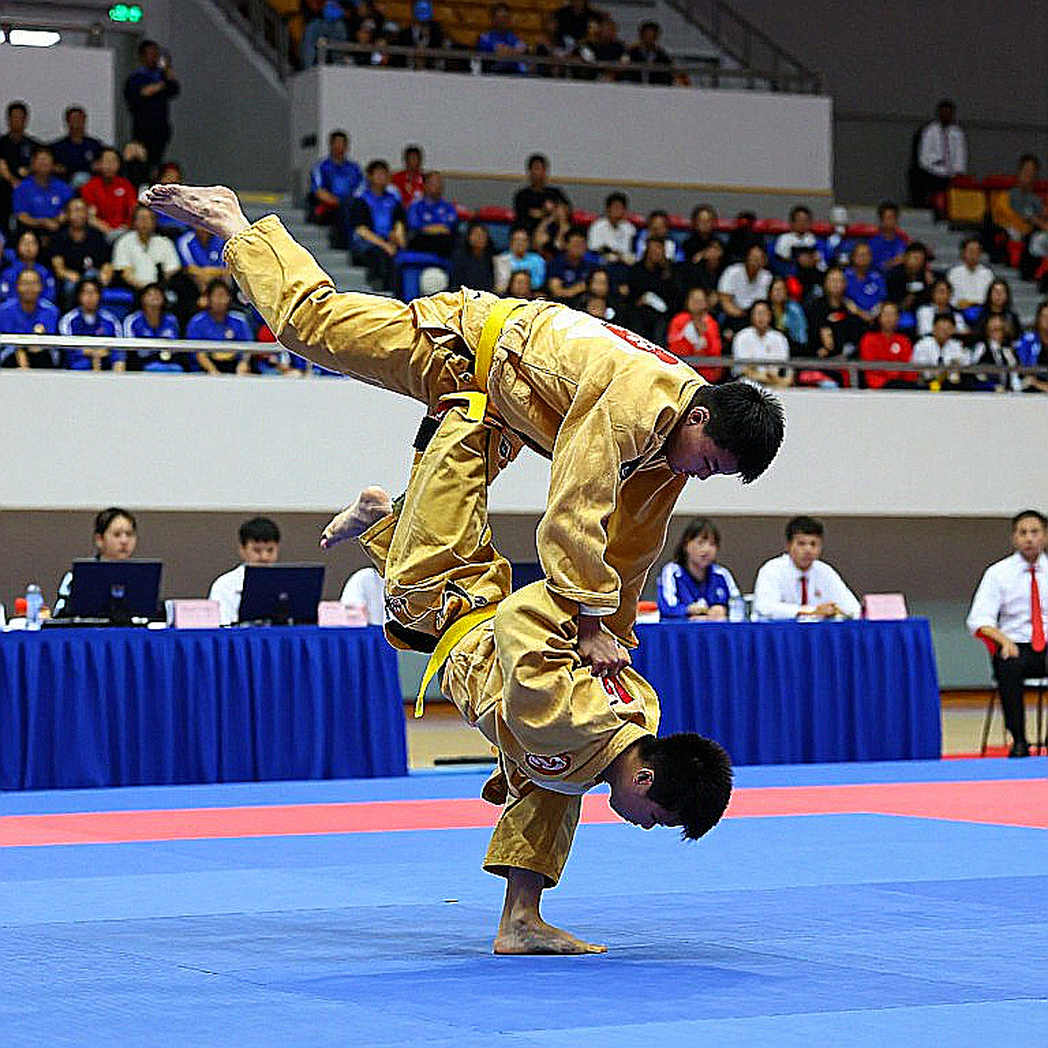
A schedule never tells the whole story. It only tells us that at 11:00, the Ju-Jitsu women's 63kg division enters its final bout; twenty-five minutes later, the men's 85kg follows. Across the hall, taekwondo and freestyle wrestling also open their books early, qualifiers first, medals after. Vietnam's delegation walks into a day where combat sports fill most of the entry list, with nine names spread across three disciplines. The first thing I noticed reading that schedule was its silence. It says who steps onto the mat, when, and in which weight class, then stops. No opponent's name. No record. No note on form. Talent is not loud; it only needs someone who listens. But here, even that quiet voice has yet to be raised.
The day has to be placed in its proper frame. The Asian Games is an amateur-federation stage, where athletes compete under the flag of a national Olympic committee, not under a professional promoter's contract. Ju-Jitsu falls under the Ju-Jitsu International Federation (JJIF), taekwondo under World Taekwondo's Kyorugi ruleset, and freestyle wrestling under United World Wrestling (UWW). Three federations, three rulesets, one shared trait: all are weight-class sports, and all open with qualification rounds.
For Vietnam, the meaning of such a day is not in a single bout. It is in the aggregate. Every result here, medal or defeat, feeds one shared medal table. In that frame, taekwondo and wrestling carry an extra layer: they sit on the Olympic programme, so results here can open Olympic qualification and ranking points. Ju-Jitsu is younger, only recently brought into the continental competition system, and its presence is a small sign of institutionalisation for a martial art once kept on the margins.
Seen from inside the arena, this creates a paradox. The athletes step out as national representatives, but what they carry is measured by the overall medal table, not by the Olympic-pathway value of the road they themselves are walking. The audience watches the standings. Those inside watch their own bracket.
The most striking thing about this competition day is not the names, but the structure. All three combat disciplines run on the same template: qualifiers first, medal rounds after, and almost all of it compressed into a single day. For Ju-Jitsu, the organisers publish exact final times: women's 63kg at 11:00, men's 85kg at 11:25. For taekwondo, the list includes Le Tuan at men's 68kg, Bac Thi Khiem at women's 67kg, and Tran Ho Nhan Van at men's 80kg. For wrestling, it is Pham Nhu Duy at men's 57kg, Nguyen Thi My Linh at women's 53kg, and Nguyen Thi My Trang at women's 57kg. On the Ju-Jitsu side, the named faces are Ngo Thi Thao Van, Nguyen Thi Minh Vuong and Nguyen Tien Trien.
The core point sits here: these are one-day single-elimination brackets, where an athlete must survive an entire draw to reach a medal, rather than being compressed into a single showcase bout. That structure changes how a competition day must be read. It means a fighter's morning is not a warm-up, but a run of real bouts. It means conditioning, recovery and hydration become larger variables than technique inside the brief hours between rounds.
In a one-day bracket, every round is a pruning. In Ju-Jitsu, where joint locks and chokes are the primary tools, the body absorbs pressure on joints and ligaments bout after bout. In taekwondo Kyorugi, where the head is a scoring target, every high-level collision is an accumulation on the brain. In freestyle wrestling, where takedowns and balance decide points, knees and shoulders bear the heaviest load. Three disciplines, three patterns of wear, all inside one short window.
With all three being weight-class sports, the pressure multiplies. Weight-cutting is a familiar but risky process: an athlete must hit the exact weight at the weigh-in, then recover quickly enough to fight multiple bouts the same day. When qualifiers and finals are compressed into a few hours, the recovery window narrows, and the cost of a single misjudged cut grows far higher than at a week-long tournament. This is structural risk, not personal risk. It comes from how the event is organised, not from any decision by the athlete.
It must also be said plainly: this schedule provides no performance data at all. No ages, no head-to-head records, no win rates, no injury history. To an analyst, that is a large gap. But the gap is itself information. It shows the piece was written before the event, with start times rather than results. And it shows how a national sports media covers its delegation: presence over analysis. Every bout is a chapter; the careful reader recognises the same book. But here, the book has only a table of contents.
Based on my experience following combat-sports bouts, most of the real information lies in what is not printed. A schedule tells us that someone will step onto the mat. It does not say when that person woke up, how much weight they cut, how many months of quiet training they endured. Numbers give us an address, but the heart is the one who points the way. And on a compressed competition day, that heart must beat calmly enough to walk through many bouts, not one.
The counter-intuitive part sits here. When a schedule grants Ju-Jitsu two specific final times while taekwondo and wrestling are listed only at the qualification stage, it is easy to read that as a signal of strength. But it is a signal of how the newsroom chose its emphasis, not of the balance of forces on the mat. It is a newsroom convention: naming the final times for events seen as medal windows. It does not prove who is stronger. It only shows what the writer believes.
Conversely, precisely because every discipline opens with qualifiers, the delegation's medal ceiling for the day is an unknown at press time. We cannot know who survives the bracket. The caution in the wording, with phrases such as "if they pass the qualifiers" or "may continue to bring notable matches", shows the writer understands this, even if the headline still leans toward encouragement. That caution is a virtue. It keeps expectations from being pushed too high before anyone touches the mat.
There is a small detail I always notice on days like this: the sound of footsteps on the mat before a bout begins. In an arena without spectators, the squeak of shoes, the breathing, the referee's commands become the entire sound of the contest. I once sat before a microphone at a match with not a single person in the stands and heard the coach's instructions clearly from the corner. Since then, I have believed that silence is not emptiness. It is where the most important things are said.
Exhaustion is not a full stop; it is the comma of an unfinished sentence. For the nine Vietnamese fighters entering this competition day, each carries an unfinished sentence. Some will run the full bracket. Some will stop at the qualifiers. The schedule does not distinguish between those two fates. It only sets the times, and leaves the rest to the mat.
Sport is a common language. But a schedule reminds us that this language has its own grammar: time, weight class, round. Behind every line is a person who must survive an entire bracket in a single day, hit the exact weight, recover quickly enough, keep a cool head amid the referee's calls. When the competition day closes, what remains goes beyond the medal. It is the question each of us reading should ask: have we read closely enough what the schedule does not say?

Cầu thủ liên quan
Bài nổi bật
Darren Yap and the Poomsae Bronze: What the Data Says About a 0.34-Point Gap2026-10-02
Raoni Barcelos Leaves Hospital After Health Scare: When Age 39 Speaks Loudest at 135 Pounds2026-10-01
Raoni Barcelos Hospitalized After Round-5 TKO Loss: Age 39 and the Bantamweight Ceiling2026-09-29
Chau Ngoc Tuyet Sang and Asiad 2026: The Real Bet Lies in a Discipline Nobody Has Written Rules For2026-09-28
Bài đề xuất
UFC 331: A Wrestler's Back Is Where Tsarukyan vs Ruffy Is Really Decided2026-09-20
Vietnam's taekwondo squad departs September 28: two women's weight classes carry the entire Asiad 2026 medal case2026-09-18
PFL CEO John Martin resigns less than two months after merger with MVP2026-09-23
Asiad 20, September 20: Bui Ngoc Nhi's Kata Bronze, the Repechage Route and the Data Gap2026-09-21
Chau Ngoc Tuyet Sang and Asiad 2026: The Real Bet Lies in a Discipline Nobody Has Written Rules For2026-09-28
Bài đề xuất
Zhang Songxi: The Ming Dynasty Tailor and the Two-Hundred-Year Gap with Wudang2026-10-05
Vietnam's Martial Arts Map and the Data Problem of an Unmeasured Industry2026-09-16
Duong Thuy Vi and Her Fourth Consecutive Asian Games Medal: Four Podiums and a Limit Worth Naming Correctly2026-09-24
Sanda at Asiad 20: Dinh Van Tam, Ou Jiaming and a Final With No Safety Margin2026-09-24
Chau Ngoc Tuyet Sang and Asiad 2026: The Real Bet Lies in a Discipline Nobody Has Written Rules For2026-09-28